
Leadership scenario animation for the conversations managers keep avoiding
You’ll talk to a learning designer about one specific role. No deck required.
Most managers already know the principles. The challenge is applying them when the conversation is uncomfortable, the pressure is real, and the easy response isn’t the right one.
The most common leadership failure isn’t a knowledge gap. It’s the daily calculation that the discomfort of the harder conversation outweighs the cost of avoiding it.
Built for L&D, HR, and talent leads responsible for how managers lead across every team, not just the naturally good ones.






Managers know the principles. The principles are not what breaks down
Most organizations already invest in leadership development: workshops, frameworks, coaching programs, and online modules covering communication, feedback, delegation, and team management.
But leadership incidents, the avoided conversation, the inconsistent feedback, the delegation that becomes micromanagement, rarely happen because managers don’t know the principles. They happen when real conversations make applying those principles harder than the workshop made it look.
Gallup has measured engagement across more than 2.5 million work units over two decades and found that managers account for at least 70% of the variance in engagement between teams. Not the company, not the pay, not the policies that apply to everyone equally. The difference between your best team and your worst one mostly traces to who is running it. (Gallup, State of the American Manager)
Leadership inconsistency isn’t a soft problem. It is the largest single source of variation you have.
The most common leadership failure isn’t a knowledge gap. It’s the daily calculation, conscious or not, that the short-term discomfort of the harder conversation outweighs the longer-term cost of avoiding it. Training that doesn’t address this calculation doesn’t change it.
What managers still do after completing leadership training
- Defaulting to old communication habits when conversations get stressful or uncomfortable
- Avoiding feedback that feels difficult to deliver, even when they know it's needed
- Treating leadership frameworks as something that applies in theory rather than in the conversation happening right now
- Recognizing the right thing to do in a training scenario and freezing when the real situation is messier than the example covered
What leadership training has to do, and whether a workshop, a course library, or coaching delivers it
Managers need to recognize the moments where the easier response becomes tempting, and understand why the harder response still matters. Five things decide whether that happens. Here is what each option does well, and where it runs out.
| F.Learning scenarios, reference tools, and the standard behind them | A workshop or offsite | An off-the-shelf course library | One-to-one coaching | A competency framework | |
|---|---|---|---|---|---|
| Names the moments that break here? | Strong: built from conversations yours avoid | Partly: covers the general categories | Weak: generic by construction | Strong: works from their real situation | Weak: names behaviour, not the moment |
| Shows why the harder response matters? | Strong: the cost of avoidance is shown before they meet it | Partly: depends on the facilitator | Partly: explains it, stakes stay abstract | Strong: personal and immediate | Weak: no |
| Holds across all your managers? | Strong: one standard, everyone | Partly: varies by cohort | Strong: identical for everyone | Weak: personal by design, so it can't set one standard | Strong: the reference document |
| Reaches each new manager on promotion? | Strong: reused at promotion, not scheduled | Weak: needs a new cohort | Strong: available the same day | Partly: budget rarely stretches that far | Partly: available, usually unread |
| Cost per manager as you grow? | Partly: high upfront, flat afterwards | Weak: recurring, grows with headcount | Strong: lowest per seat | Weak: highest by far, and worth it for one leader | Strong: near zero |
| Best when | many managers avoid the same conversation | a small group needs to talk it through | managers don't know the principles yet | one senior leader has a persistent problem | you need a written standard to point to |
👈 Swipe horizontally to view full table 👉
In short: Coaching is the strongest way to change one manager, and the most expensive per person. A course library is the cheapest way to cover the principles. A framework is the written standard worth keeping either way. F.Learning is strongest when many managers avoid the same conversation and the inconsistency between them is already costing you.
Before

After
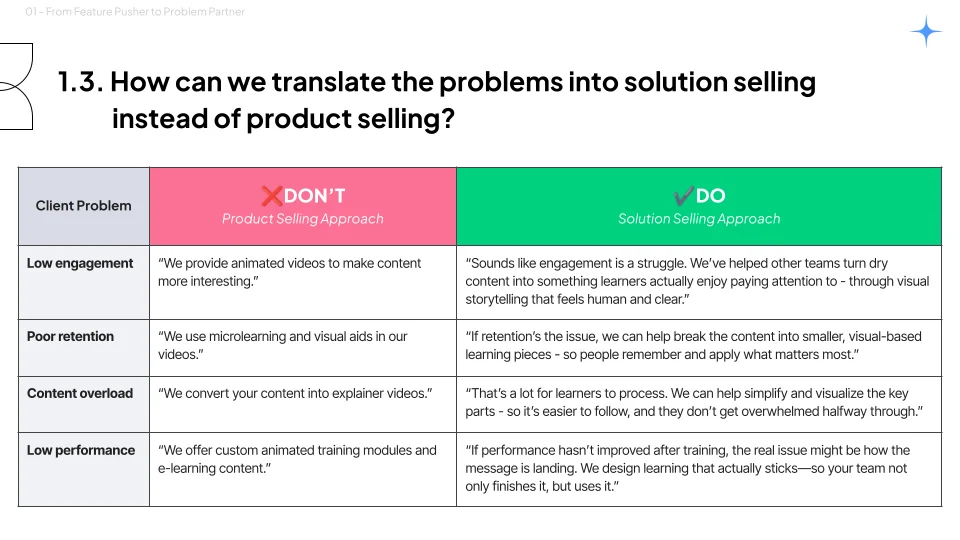
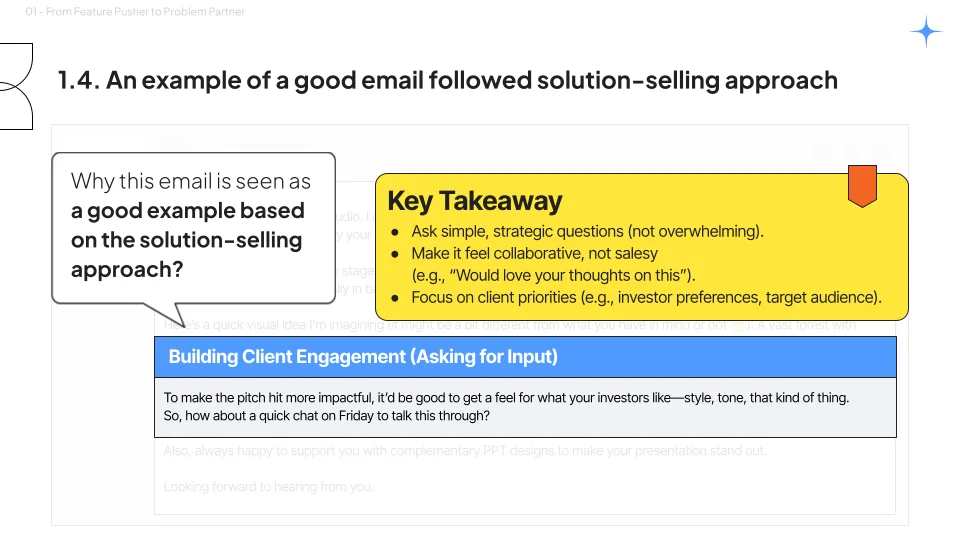
The same feedback conversation, as a principle and as a scenario. The marked moment is where most managers soften the message, and where the scenario stops to make that choice visible.
Where this isn’t the right answer
For one senior leader with a specific, persistent problem, coaching will outperform anything we build, and at that level it is worth the money.
This work earns its cost when many managers avoid the same conversation, and the inconsistency between them is already producing visible friction.
What F.Learning designs for: the moment before the conversation
Most leadership training teaches the principles of what good feedback, delegation, or a difficult conversation is supposed to look like. Managers already know the principles. What breaks down is applying them in the moment, when the easy response and the right response aren’t the same thing.
That moment is specific and it is knowable. It is the performance conversation that has been deferred three times. It is the delegation that gets taken back the first time the work comes in at eighty percent. It is the piece of feedback that gets softened until the other person doesn’t realise anything was said.
So the scenarios get built from those moments, in your organization, surfaced with HR and with managers before anything is written. And each one is tested against three questions: does this feel like something a manager here has actually been in, does the wrong response feel genuinely tempting rather than obviously bad, and does the better response feel achievable rather than aspirational.
A scenario that fails the second question teaches nothing. A scenario that fails the third one teaches managers that the standard isn’t meant for them.
The conversation is needed
Doing ot well costs discomfort now
Scenarios start here
Avoiding it costs nothing today
It gets deferred again
The problem compounds and the standard erodes
Where F.Learning designs
What happens by default
The costs
Nothing here is a knowledge gap. Every step is a choice that felt reasonable at the time.
We focus specifically on
- Designing for the uncomfortable moment, not the concept. Practice happens at the point where a manager is tempted to avoid or soften the conversation
- Building judgment through scenarios, not scripts, so managers can adapt to a conversation that doesn't go as planned
- Making the cost of avoidance visible: what happens when a hard conversation is delayed or diluted, not just what to say
- Reinforcing consistency across managers, so "how we give feedback here" doesn't depend on who's naturally good at it
Selected example
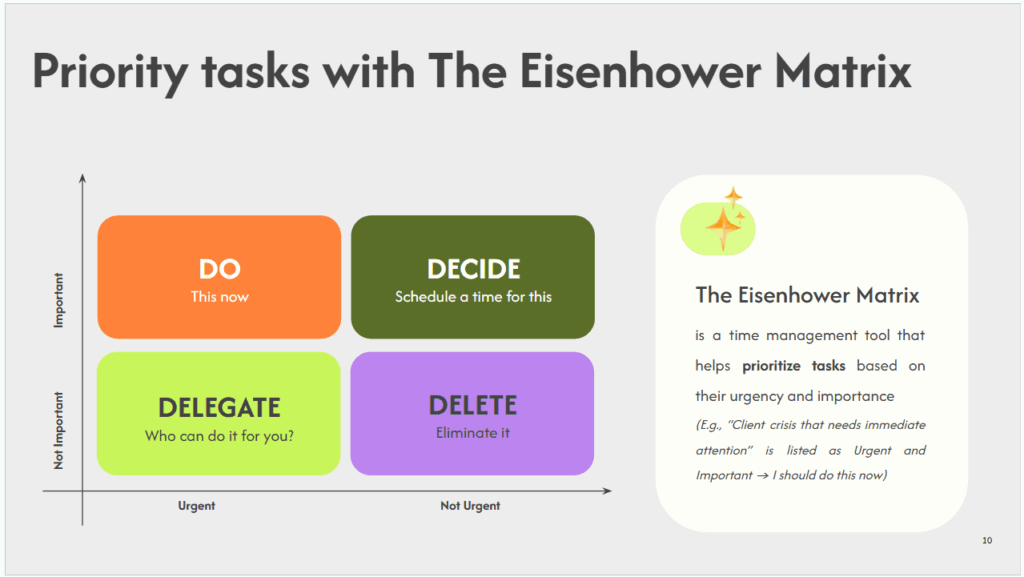
Integrity and values training for leaders and managers
A company needed leaders to model integrity consistently, but values were agreed at the level of principle and gray-area situations were producing inconsistent decisions across managers.
We turned values training into scenario-based animation showing what integrity looks like in real work situations, the common gray-area moments where the easy shortcut feels justified, and specific actions managers could take in ambiguous situations.
- More consistent decisions across managers in unclear situations
- Clearer behavioral standards that didn’t depend on personal interpretation
- A shared reference point for what “doing the right thing” looks like in this organization
Selected example
Leadership training for overloaded team leads
Team leads had become bottlenecks. Everything needed their approval, delegation wasn’t happening, and the team was waiting rather than moving. The problem wasn’t that leads didn’t know they should delegate. It was that the habit of staying in control felt safer than the risk of letting go.
We built a short visual course showing what “staying in control” habits actually cost the team in real operational terms, simple decision tools for what to own, share, or delegate, and real scenarios with practice prompts to build different response patterns.
- Leaders delegating with more confidence and less second-guessing
- Fewer approval loops slowing team progress
- Teams operating with more ownership and less reliance on the lead for decisions

Where this applies
- Leadership development: From a first promotion into people management through to advanced leadership responsibility.
- People management: Coaching, evaluating, delegating, and leading a team through real performance situations.
- Communication skills: Internal updates through to high-stakes stakeholder conversations.
- Change management: Translating strategic direction into behaviour people can actually follow.
- Workplace collaboration: Cross-functional work and the friction that comes with it.
Specific applications in each area
- Leadership development: first-time manager training, leadership fundamentals, executive development, promotion readiness
- People management: performance management, coaching skills, delegation, team leadership
- Communication: business communication, presentation skills, stakeholder communication
- Change: leading through change, organizational transformation, change communication
- Collaboration: cross-functional collaboration, conflict resolution, team effectiveness
Where leadership is breaking down, and what to build for each case
The calculation is the same everywhere. Where it shows up is not.
When leadership concepts stay abstract and don't translate into action
Content structuring (Content Structuring) | Behaviour-focused learning resources (Documents & Graphic Design) | Interactive behaviour practice (Interactive Learning Design)
Best suited for organizations introducing new leadership frameworks, values, or competency models that haven’t yet been defined in concrete, observable terms.
When managers avoid or mishandle specific difficult conversations
Scenario-based training animation (Training & Education Animation) | interactive conversation simulations (Interactive Learning Design)
Best suited for feedback training, conflict navigation, performance conversations, and any context where the gap is recognizing the right moment to act, not understanding the principle.
When judgment must be applied consistently in ambiguous situations
Best suited for delegation training, people management, and leadership situations with no single correct answer, where the goal is building judgment rather than memorizing a procedure.
When leadership standards need to stay consistent across managers and teams
Interactive learning (Interactive Learning Design) | Scenario-based decision practice (Training & Education Animation)
Best suited for organizations scaling leadership development across many managers, distributed teams, or recurring onboarding of new people leaders.
How F.Learning builds it: five steps, 5 to 8 weeks, with scenarios tested on real managers
Leadership training starts from a constraint most other training doesn’t have. There’s no regulatory document or fixed procedure to translate. The definition of good has to be established first, and it has to come from inside the organization.
Step 1
Define what good looks like in this specific context
We work with HR, L&D, and senior stakeholders to translate leadership principles into concrete behavioural terms relevant to this organization.
What this step covers
- What accountability, feedback, or empathy actually looks like in a real conversation here
- Which leadership moments matter most in this culture and operating environment
- Where leadership currently breaks down: the conversations avoided, the patterns that repeat
Step 2
Map the real moments where leadership breaks down
We work with managers and HR partners to identify the specific situations where leadership most commonly fails in this organization.
What this step covers
- The conversations that get avoided or softened until they lose meaning
- The delegation patterns that quietly become micromanagement
- The situations where inconsistent leadership creates the most team friction
Step 3
Build and test scenarios collaboratively
Scenarios are developed iteratively: written, reviewed with actual managers, and refined until they feel real rather than idealized.
Each scenario is tested against three questions
- Does this situation feel like something a manager has actually been in?
- Does the wrong response feel genuinely tempting, not obviously bad?
- Does the better response feel achievable rather than aspirational?
This is the step most leadership content skips, and it is why most leadership content feels like it was written for someone else’s company.
Step 4
Organizational and cultural review
Leadership training requires sign-off confirming the content reflects this organization, not leadership theory in general.
What this step covers
- Scenarios that feel like "us": matching the culture, tone, and actual situations of this organization
- Alignment with the company's stated values and operating style
- Language and standards that managers and HR are prepared to reinforce consistently
Step 5
Prepare for ongoing reinforcement and scale
Leadership behaviour change rarely holds from a single training moment. Deliverables are designed for reuse across onboarding, refreshers, and team-wide rollout, so the standard stays consistent as new managers join.
Related insight
More on leadership and manager capability:












Related services & solutions
Related Training Solutions
Related Services
Frequently asked questions
What types of leadership and communication training does F.Learning support?
How is scenario-based leadership training different from a standard workshop?
How do you address experienced managers who feel they already know this?
How do you train judgment when there's no single correct answer in leadership?
How long does a leadership and communication training project typically take?
How much time will this take from our team?
For a typical leadership or communication training project, plan for around 5–8 hours of your team’s time in total.
This usually includes 2-3 hours with HR or L&D to define the target behaviours and situations, plus 2-3 hours across a small group of managers to review and challenge the scenarios. Allow another 1-2 hours for final review and approval.
F.Learning handles the content structuring and production between those stages.
What does a leadership training project cost?
A focused leadership or communication training module typically starts around 3,000-6,000 for a basic version, with mid-level interactive or scenario-based modules at 6,000-12,000, and more complex, multi-scenario programs costing more.
Final cost depends on how many leadership behaviours or conversation types need to be covered, how many scenarios are required, and whether the solution includes animation, interactive practice, reference tools, or a combination.
We normally start with one recurring leadership situation and build the smallest useful intervention around it before expanding into a larger program.
You can also use our Animation Cost Calculator for an initial ballpark.
Does this work with our LMS?
Yes. We can prepare leadership training for common LMS platforms such as Moodle, including SCORM 1.2 and SCORM 2004 packaging where required.
If your LMS has specific tracking, reporting, or file-format requirements, let us know during scoping so we can confirm the right delivery format before production begins.
Is the content accessible?
Accessibility requirements can be planned into the project from the start, including captions, transcripts, and supporting formats where required. If your organization works to a specific WCAG standard or internal accessibility requirement, define that during scoping so it can be included in the design and review criteria.
Can we get this in other languages?

The training addressed the principle, not the moment where it's hardest to apply. Pick the one conversation your managers avoid most often, and we'll map what actually happens in it before anyone talks about production.
30 minutes with a learning designer. No deck required.