
Exam prep animation for learners who feel ready and still underperform
You’ll talk to a learning designer about one specific process. No deck required.
Most teams already have the procedures documented. The real challenge is running them the same way when the situation shifts, when the documented flow doesn’t quite match reality, and when different people, shifts, and sites each read the process a little differently.
Built for legal, compliance, and HR teams who need training built around their own policies, not a generic licensed course.








People learn the steps. What they don't learn is the system that holds the steps together.
Process compliance rarely fails because people never learned the procedure. It fails because the procedure was learned as a list of steps rather than a working system.
When training presents a process as a sequence of instructions to complete, people can pass the assessment and still not understand how the steps hold together: why this check comes before that action, what each step is actually protecting against, where the sequence can flex and where it cannot. The steps get remembered. The logic that connects them does not.
Most teams budget for non-compliance as a fine. The largest study of what it actually costs found the opposite: fines and penalties were the smallest category, business disruption the largest, and indirect costs like downtime and lost productivity made up 43% of the total. (Ponemon Institute, The True Cost of Compliance, 2011 and 2017)
The shortcut that never causes an incident still costs something. It just doesn’t arrive as an invoice.
The gap stays invisible while conditions are familiar. The moment reality diverges, when an exception the SOP never covered appears, when a step doesn’t apply cleanly, when two procedures seem to conflict, people have nothing to reason from. So they fall back on habit, or copy whoever sits nearby.
What people still do after completing the training
- Skipping steps to maintain production pace or meet deadlines
- Taking shortcuts that "everyone does" and that have never visibly caused a problem
- Applying procedures correctly in familiar situations but deviating when conditions change
- Following the spirit of a rule rather than the specific step, because the two feel equivalent
- Treating compliance as something that matters during audits rather than during daily work
What compliance training has to do, and whether an off-the-shelf course, an annual briefing, or a policy sign-off delivers it
Most teams already run something. The question isn’t whether people were trained. It’s whether the process runs the same way when the situation stops matching the documented flow.
Five things decide that. Here is what each option does well as it is usually deployed, and where it runs out.
| F.Learning usually a module and a job aid together | A written policy | An off-the-shelf course | An annual briefing or deck | Read-and-acknowledge | |
|---|---|---|---|---|---|
| Shows the process as one system? | Strong: the logic connecting the steps is what gets designed | Weak: records the steps, not the logic | Weak: teaches the rule, not your process | Partly: depends who runs the session | Weak: no |
| Shows what each step prevents? | Strong: sourced from your real incidents | Weak: documents the action only | Partly: generic consequences, not yours | Partly: strong when a real story is told | Weak: no |
| Helps people handle exceptions? | Strong: scenarios from your deviations | Weak: covers only anticipated cases | Weak: no | Strong: a person answers the case nobody planned for | Weak: no |
| Same on every shift and site? | Strong: one version, every site | Partly: interpretation still varies | Strong: identical for every company | Weak: varies with the trainer | Strong: consistent |
| Produces evidence for an audit? | Partly: SCORM and tracking, to confirm | Strong: the document auditors read | Strong: tracking and updates built in | Weak: attendance sheets, if kept | Strong: cheapest proof everyone was told, and nothing more |
| Best when | the gap is execution, not awareness, and one bad run is costly | you need the record of truth | the rule is generic and changes often | a recent incident needs discussing now | you only need proof everyone was told |
👈 Swipe horizontally to view full table 👉
In short: An off-the-shelf course is cheapest per seat and comes with tracking. The written policy stays the record auditors read. A briefing is the only option that can answer a question nobody anticipated. F.Learning is strongest where people already know the rule and still deviate under pressure, and it is the most expensive to produce.
Input
Output
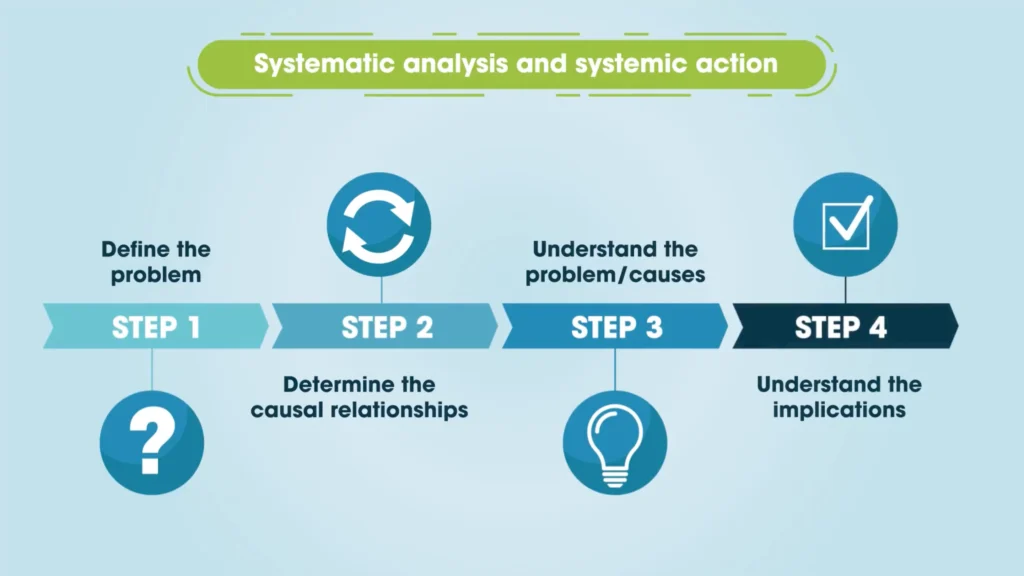
The same procedure, as written and as designed. The written version is accurate. What it doesn’t carry is which step the night shift skips when the line is behind, and what that step was holding up.
Where this isn’t the right answer
If the requirement is evidence that everyone was informed by a deadline, an off-the-shelf course plus an acknowledgement does that faster and for far less. We will say so rather than build you something more expensive that satisfies the same audit line.
This work earns its cost when the gap is execution rather than awareness, and one inconsistent run carries safety, regulatory, or product-quality consequences.
What F.Learning designs for
The dangerous deviation isn’t the one someone knows is wrong. It’s the one that has worked every single time so far.
A step gets skipped, nothing happens. It gets skipped again, nothing happens again. After the twentieth time it isn’t a shortcut any more, it’s just how the job is done, and the person doing it would be genuinely surprised to hear it described as non-compliance. The consequence the step exists to prevent is rare by design. That is exactly what makes the step feel optional.
So we design for that specific problem: making a delayed, statistical consequence legible in the moment the shortcut is taken. Not the rule, and not the penalty. What the step is actually holding up, and what the twentieth time looks like when it finally goes wrong.
It then has to survive two reviews that ask different questions. Legal asks whether the content is accurate. Operations asks whether anyone could realistically do this at 3am on a short-staffed shift. Training that passes only the first one is the training people quietly work around.
Step skipped once
Training works here
Nothing goes wrong
The consequence is invisble
Skipped again, and again
It become the method
Nobody calls it non-compliance
The rare consequence finally lands
Where F.Learning designs
What happens by default
The costs
Nothing in week one is a correction. Everything in week one is a first impression, and first impressions set.
Selected example
IntelyCare: turning ethics and compliance requirements into practical guidance for clinical staff
A long-term care training provider needed to cover a dense set of ethical and regulatory requirements for clinical staff – from residents’ rights and HIPAA privacy to reporting violations, discrimination, harassment, and retaliation.
The challenge was to make these requirements easier to understand without oversimplifying the responsibilities behind them. We structured the content around the situations and decisions staff may encounter at work, connecting regulations to what they mean in practice: respecting a resident’s choices, protecting health information, recognizing inappropriate behavior, and knowing when action or reporting is required.
Result
The training brought multiple ethics and compliance requirements into one structured learning experience, giving clinical staff a clearer connection between the rules they are expected to follow and the decisions they make in day-to-day resident care.
Instead of presenting compliance as a collection of regulations to remember, the content framed it around practical responsibilities toward residents, colleagues, and the organization.
Working in a hospital or clinical setting? See clinical safety & compliance training.

Where this applies
- Safety training: Critical procedures in environments where a mistake carries operational, financial, or physical risk.
- Regulatory & process compliance: Standards, requirements, and operating procedures across regulated environments.
- Cybersecurity: Recognising risk and applying correct security behaviour in daily digital work.
- Quality & risk management: Quality systems, CAPA, audit readiness, and root cause work.
- Workplace compliance: Code of conduct, ethics, reporting procedures, and workplace policy.
Specific applications in each area
- Safety: workplace safety procedures, equipment operation, manufacturing compliance, hazard awareness, incident prevention
- Regulatory: quality assurance procedures, regulatory compliance, GDPR and HIPAA, process adherence
- Cybersecurity: phishing awareness, information security practice, data handling, security behaviour reinforcement
- Quality & risk: QMS, CAPA, risk management education, audit readiness, root cause analysis
- Workplace: code of conduct, anti-harassment, ethics and integrity, DEI, whistleblower and reporting procedures
Where your process is breaking, and what to build for each case
The mechanism is the same everywhere. Where it surfaces is not. Different compliance challenges need different approaches.
When procedures are complex, dense, or difficult to follow
Content structuring (Content Structuring) | Visual SOP and workflow training (Motion graphic) | Workflow and internal communication assets (Documents & Graphic Design)
Best suited for procedural documentation, compliance workflows, regulatory requirements, and process-heavy environments.
When shortcuts and procedural deviations are common
Best suited for safety training, operational compliance, behavioural reinforcement, and risk reduction initiatives.
When critical decisions must be applied consistently under pressure
Best suited for operational decision-making, compliance reinforcement, healthcare safety training, and high-risk environments.
When long-term recall and procedural consistency matter
Best suited for recurring compliance requirements, ongoing procedural learning, and distributed workforces.
How F.Learning builds it: five steps, 4 to 8 weeks, and two review passes
Step 1
Audit existing materials and map the compliance gap
We begin with existing procedures, compliance documentation, and operational requirements, to find where documented procedure and actual behaviour have separated.
What this step covers
- Commonly skipped steps
- Frequently modified procedures
- Situations where deviation feels justified
- Operational pressures that influence decision-making
Step 2
Translate regulatory requirements into behavioural steps
We convert policy language and procedural requirements into clear behavioural expectations.
What this step covers
- What employees need to know
- What employees need to do
- Why each step exists
- What happens when critical steps are skipped
Step 3
Design scenarios around the real deviation conditions
Scenarios are built from the operational situations where non-compliance actually occurs, not from textbook cases.
What this step covers
- Production pressure
- Deadline-driven decisions
- Ambiguous situations
- Operational edge cases
Step 4
Prepare for tracking, deployment, and audit
Deliverables are prepared with the deployment environment in mind, so nothing has to be rebuilt to satisfy a tracking or record requirement later.
What this step covers
- LMS integration and completion tracking
- SCORM packaging where required
- Certification record support
- Audit documentation alignment
Step 5
Two review passes, with different owners and different criteria
Compliance content has to survive two separate reviews, and they don’t ask the same question. We run both rather than collapsing them into one sign-off.
What each pass checks
- Compliance and legal: is the content legally accurate and regulation-compliant?
- Operations and safety: is the content operationally realistic and applicable under real work conditions?
Related insight




















Related services & solutions
Related Training Solutions
Related Services
Frequently asked questions
What kinds of compliance and process-driven training does F.Learning support?
How is this different from standard policy-based training?
Our completion rates are already high. Why is the process still inconsistent?
Because completion tests whether people can recall the steps, not whether they understand how the steps connect. When the connecting logic is never made visible, people follow the flow correctly in familiar conditions and diverge the moment conditions change. We design training around that gap specifically.
Can you work from our existing SOPs and compliance documentation?
How long does a process-driven training project typically take?
How much time will this take from our team?
For a typical compliance training project, plan for around 5-8 hours of your team’s time in total.
This usually includes 2-3 hours with SMEs to map the process and validate scenarios, plus 1–2 hours per review round with your legal/compliance and operations teams. We handle the content structuring and production between reviews, so your specialists only step in where their expertise or approval is needed.
What does a compliance training project cost?
A focused compliance training project typically starts from around $3,000 for a basic module, with final cost depending on process complexity, scenarios, and formats.
For context, off-the-shelf compliance platforms usually charge per user per year (~20-50/learner), so a small to mid-sized team might spend 4,000-6,000+ annually. Customized course packages commonly run 8,000-12,000 per course, with fully tailored programs costing more.
We normally start with one defined process and recommend the smallest format that solves the execution gap-animation, interactive practice, job aids, or a combination.
You can also use our Animation Cost Calculator for an initial ballpark.
Which LMS platforms do you deliver to?
We can prepare training for common LMS platforms such as Moodle, including SCORM 1.2 and SCORM 2004 packaging where required.
We can also support xAPI where your LMS or learning environment uses it for tracking.
If your LMS has specific tracking, certification, reporting, or file-format requirements, let us know during scoping so we can confirm the right delivery format before production begins.
Is the content accessible?
Can we get this in other languages?
Who owns the files after delivery?
You own the final compliance training videos or learning materials delivered to you and can use them within the agreed scope.
The underlying production assets – such as artwork, illustrations, storyboards, audio assets, and working files – remain the intellectual property of F.Learning Studio. If your team needs editable source files for future policy or process updates, they can be included for an additional 10–30% of the project fee, depending on the files required.
We’ll confirm the ownership, usage rights, and delivery package before production begins so everything is clear from the start.

If people finish the training and still run the process differently across teams and sites, the training teaches the steps but not the system that holds them together. Pick the one process where that gap costs you most, and we'll map where it actually fragments before anyone talks about production.
30 minutes with a learning designer. No deck required.