
Change communication animation for messages that have to survive the cascade
You’ll talk to a learning designer about one change and where it’s likely to be read differently.
We turn strategy updates, new directions, and change initiatives into visual explanations people understand quickly, interpret the same way, and act on consistently, at every level of the organization.







The change didn't fail. It landed differently in every team
Most organizations communicate change thoroughly. Town halls happen. Decks get shared. Managers cascade the message. And then execution diverges anyway.
The problem is rarely that the information wasn’t delivered. It’s that different people formed different interpretations, and nobody noticed until the gap showed up in behaviour weeks later. Leadership hears what it wants to hear in the follow-up meeting. Front-line teams do what feels reasonable to them, which is often a version of what they were already doing.
Count the layers between your executive team and the front line. That’s how many times your message gets retold before anyone acts on it, and each retelling is made by someone who already had a view.
The most common change communication failure isn’t resistance. It’s the organization operating under the assumption that the change landed, while teams quietly interpret it in ways that range from correct to completely divergent.
What teams are still unsure about after the announcement
- What exactly is different from what they were doing before
- What this means for their specific role, decisions, and daily work
- Which current habits to stop, and which to keep
- What "doing this correctly" looks like when the situation is ambiguous
What internal & change communication has to do, and whether a town hall, a launch deck, or the manager cascade delivers it
A rollout doesn’t fail because people missed the announcement. It fails because the organization never aligns on what the change means in practice.
How internal & change communication options compare: what each one is strong at, and when to choose it.
| F.Learning one core explanation, built for the cascade | A town hall or all-hands | The launch deck | The manager cascade | An intranet article and FAQ | |
|---|---|---|---|---|---|
| Explains why the change is happening? | Strong: the reasoning is built in | Strong: people need to see leadership say it | Partly: states it, rarely remembered | Partly: as well as each manager understood | Partly: states it |
| Concrete enough for daily decisions? | Strong: specific before and after behaviour | Weak: too high level by design | Weak: usually too high level | Strong: when the manager translates well, which is also the risk | Partly: sometimes |
| Survives the cascade intact? | Strong: managers show the same asset instead of paraphrasing it | Partly: heard once, then retold | Partly: travels, but without the voice that made it make sense | Weak: bends at every layer | Strong: consistent, if read |
| Still there three months later? | Strong: built as a reference, not an event | Weak: no | Weak: buried in a shared drive | Partly: only if the manager repeats it | Strong: easy to keep current |
| Cost and effort to produce? | Weak: highest, and needs leadership time | Partly: a day of preparation | Strong: already being made anyway | Strong: no production cost | Strong: cheap to write and update |
| Best when | the same change is landing differently in every team | people need to hear it from leadership | the audience is in the room with you | one team needs a local translation | people need somewhere to check later |
👈 Swipe horizontally to view full table 👉
In short: A town hall is irreplaceable for the why, and nothing substitutes for leadership saying it in person. The intranet is cheapest to keep current. The manager cascade translates best and drifts most. F.Learning is strongest at the version that has to survive three retellings and still mean the same thing on the front line.
Situation
Solution
One announcement, three retellings. Each version is reasonable. None of them is the same.
Where this isn’t the right answer
A town hall is irreplaceable for the why and no animation substitutes for leadership standing behind a change in person.
This work earns its cost when the same change is landing differently in every team, and the versions have already started to diverge.
What F.Learning designs for: the third retelling
A change announced once gets retold at least three times before it reaches the people who have to act on it: by the executive team, by each department head, by each line manager. Each retelling is reasonable. Each one also bends the message slightly toward what that person already believed.
So we don’t design the announcement. We design the version that is still intact after the third retelling: the specific behaviours that change, stated concretely enough that nobody has to reinterpret them, in a form a manager can show their team instead of paraphrasing.
Leadership defines the change
Version 1
Department heads retell it
Version 2
We design for this
Line managers retell it again
Version 3
The front line acts on version 3
Where F.Learning designs
What happens by default
The cost
Nobody distorts the message on purpose. It drifts one reasonable retelling at a time.
We focus specifically on
- What's genuinely different between the current and intended way of working, at the behavioural level
- Where teams will misinterpret the change, closing those gaps before rollout
- Strategy language translated into day-to-day terms front-line teams can act on
- One visual reference every level can use, so the message doesn't depend on each manager
Where the change is breaking down, and what to build for each case
Different change challenges need different approaches.
When the strategy feels too broad or abstract for employees to act on
Clear message frameworks (Content Structuring) | Role-based strategy explanations (Explainer & Product Animation) | Visual strategy maps (Documents & Graphic Design)
Best suited for new strategies, operating models, and transformation plans people understand at a high level but can’t apply to their own work.
When people hear about the change but don't understand why
Change story videos (Character Animation) | Before-and-after process visuals (Explainer & Product Animation)
Best suited for restructuring, technology adoption, and changes likely to create uncertainty or conflicting interpretations.
When employees need to make different decisions or adopt new behaviours
Realistic workplace scenarios (Character Animation) | Interactive decision practice (Interactive Learning Design)
Best suited for culture change, new management expectations, and initiatives that depend on applying the change, not just knowing it.
When the message must stay consistent across teams, locations, and stages
Modular communication toolkits (Content Structuring) | Manager-ready rollout resources (Documents & Graphic Design)
Best suited for distributed organizations, multi-phase transformations, and multilingual rollouts.
Selected example
Selected example
Guardian Group: a new HR strategy explained once, the same way, to every team
New HR strategy rollout, financial services
A large financial services group launched a new HR strategy and updated performance system, but the message lived in dense documents employees didn’t engage with. People received the information, interpreted it differently, and buy-in stayed inconsistent across teams.
We redesigned the strategy into short, structured learning media showing:
- The key messages and what employees should take away
- How the strategy affects day-to-day work and decisions
- The behaviours leadership wanted to reinforce
Result
The rollout gave employees across teams a consistent, visual explanation of the new strategy, while using characters and environments that felt recognisable to the organisation and its Caribbean workforce.
Employees responded positively to seeing themselves and their workplace reflected in the video, making the strategy feel more relatable and increasing their interest in engaging with the content.
“Your team has done an outstanding job creating these characters with a Caribbean look. I can see elements from the photos I provided reflected in the organisation through these images.” – Ranuca Hamlet, Lead Specialist – Talent Management at Guardian Group
They also noted the attention given to individual visual details, with each element deliberately selected to support the story and learning experience.
For an expert audience already familiar with the individual technologies, the visualization shifted the conversation from what each component does to how the system works together as a whole.
How F.Learning builds it: four steps, 4 to 8 weeks, designed for the cascade
Step 1
Map the gap between current and intended behaviour
We define what’s actually different, at the behavioural level rather than the strategic one.
What this step covers
- What teams currently do that needs to change
- What the new behaviours look like in specific daily situations
- Where resistance or misinterpretation will first appear
Step 2
Identify and close interpretation gaps in advance
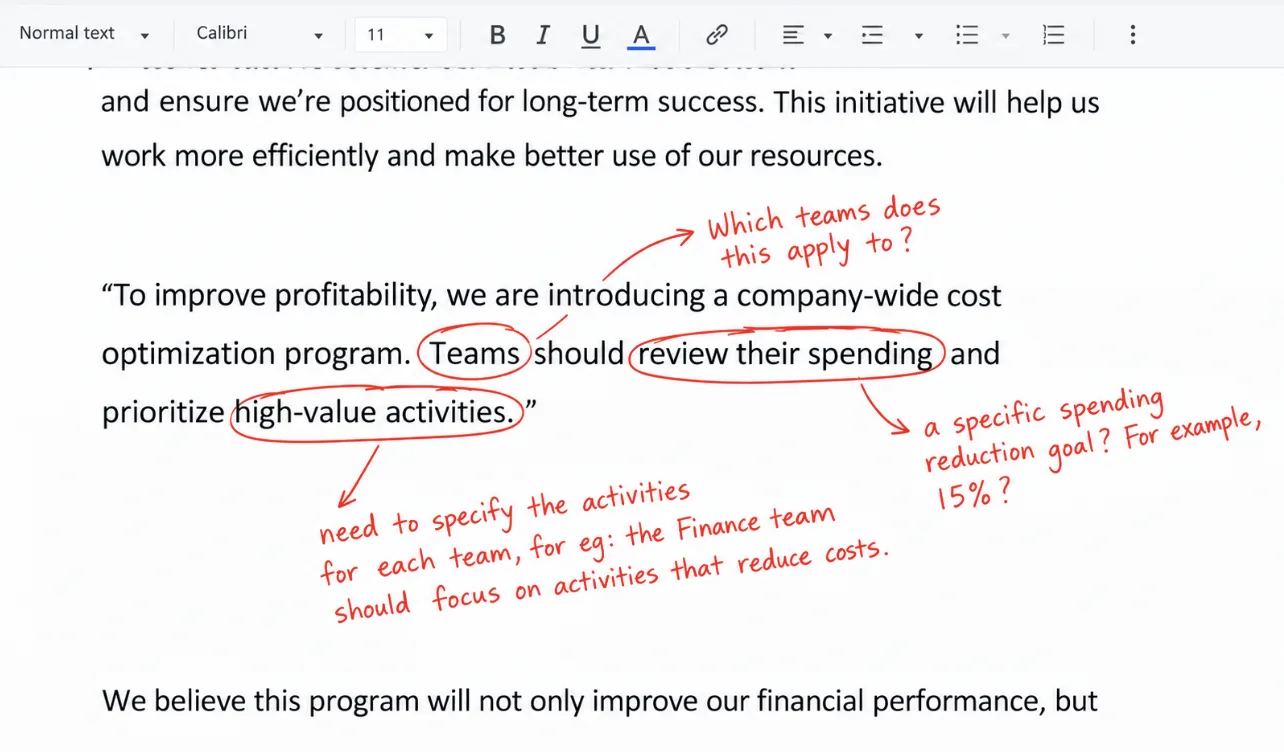
Change communication fails in the questions it leaves unanswered, which each team then answers differently.
What this step covers
- Where strategy language can be read more than one way
- Which teams need the most specific translation
- What the change means for each audience
Step 3
Translate strategy into concrete, repeatable language
Leadership language is built for strategic clarity. Daily work needs behavioural specificity: what do I do differently on Monday morning.
What this step covers
- High-level direction turned into specific actions
- Before-and-after made concrete
- The reasoning built in, so adoption comes from understanding
Step 4
Design for the cascade and beyond
The communication has to survive the hierarchy and outlast the kickoff.
What this step covers
- One visual reference each level uses without reinterpreting it
- Reference material for daily work, not just the launch
- Assets for manager-led conversations, all-hands, and self-review
Related insight
More on change communication





Related services & solutions
Related Training Solutions
Related Services
Frequently asked questions
What's the difference between internal change communication and a town hall?
How do you make strategic language concrete enough for front-line teams?
Can the same communication work for leadership, managers, and front-line teams?
How do you address resistance to change?
How long does an internal change communication project take?
How much time will this take from leadership?
For a typical internal change communication project, plan for around 2-4 hours of leadership time, plus 5-8 hours from your Internal Comms or HR team across the project.
Leadership is mainly involved upfront to align on the strategy, key messages, and intended behaviour change, then again for final approval. Internal Comms or HR works more closely with us to translate that direction into audience-specific communication and review the content as it develops.
We handle the communication design and production in between.

Pick the change your teams acknowledged but are still working around. We'll find where it's being read differently, before anyone talks about production.
30 minutes with a learning designer. No deck required.