
Exam prep animation for learners who feel ready and still underperform
You’ll talk to a learning designer about one subject where your pass rates don’t match your completion rates.
We turn dense, complex knowledge into clear visual learning media that helps learners build genuine understanding of core concepts: the kind that holds under time pressure, transfers to novel questions, and doesn’t collapse when the exam looks different from the practice.
Built for curriculum leads, instructional designers, and course producers at edtech platforms, universities, and publishers, and experts turning their own knowledge into a course.






Learners aren't studying too little. Studying is producing the wrong thing
Most learners preparing for high-stakes exams put in real effort. They complete the course, review the notes, and work through practice questions. The problem is not usually a lack of studying.
The problem is what studying produces. Most exam preparation builds familiarity. Learners recognize concepts when they see them, follow explanations as they’re delivered, and feel like they understand. Then the exam presents the same concept in a slightly different form, under time pressure, and the understanding that felt solid doesn’t hold.
In 2025, first-time US-educated candidates passed the NCLEX-RN at 86.7%. On a repeat attempt that fell to 52.7%. (NCSBN, 2025 NCLEX Examination Statistics)
A 34-point cliff between the first sitting and the second says something uncomfortable: whatever learners do between failing and retaking mostly isn’t working. The preparation that counts is the preparation before the first attempt.
The gap between recognition and retrieval is what most exam preparation fails to close.
What learners are still unsure about on exam day, having covered all the material
- Why a concept works the way it does, not just what it is
- How two related concepts actually differ when a question forces a precise distinction
- Which principles apply to a novel scenario they haven't seen before
- Why they keep getting a certain type of question wrong despite reviewing the content
What exam preparation has to do, and whether lecture recordings, a revision guide, or a question bank delivers it
Exam preparation changes outcomes when learners can recognize the type of question that exposes a shaky concept, and have already built the mental model that holds up when it’s tested from an unfamiliar angle. Five things decide that.
| F.Learning concept architecture, then the media | Recorded lectures | A textbook or revision guide | A question bank | Live tutoring | |
|---|---|---|---|---|---|
| Builds a model of how concepts connect? | Strong: mapped before any content, in the order understanding forms | Partly: follows syllabus, not understanding | Partly: complete, but they build it | Weak: tests the model, doesn't build it | Strong: rebuilds the missing link |
| Explains the mechanism, not the definition? | Strong: mechanism is what gets designed | Partly: depends on the lecturer | Partly: dense topics get compressed | Weak: no | Strong: one learner at a time |
| Builds retrieval, not recognition? | Partly: some practice, not at volume | Weak: no | Weak: worked examples build recognition | Strong: exactly what it is for, and at volume | Strong: strong, and adaptive |
| Fixes misconceptions before the exam? | Strong: designed against the known ones | Weak: only if raised in passing | Partly: flagged, rarely designed around | Partly: reveals them, after the learner already got it wrong | Strong: caught live |
| Works for thousands of learners? | Strong: built once, same for everyone | Strong: scales at recording quality | Strong: scales | Strong: scales | Weak: one tutor per learner |
| Best when | the same misconceptions appear across thousands | the lecture is the course you already have | learners need one complete reference | learners need volume of practice | a small cohort with tutor access |
👈 Swipe horizontally to view full table 👉
In short: A question bank is the best way to build retrieval, and we usually recommend running one alongside. Tutoring beats designed media for a single learner on almost everything except cost. F.Learning is strongest where the same misconceptions appear across thousands of learners and more content isn’t fixing them.
Input
Output
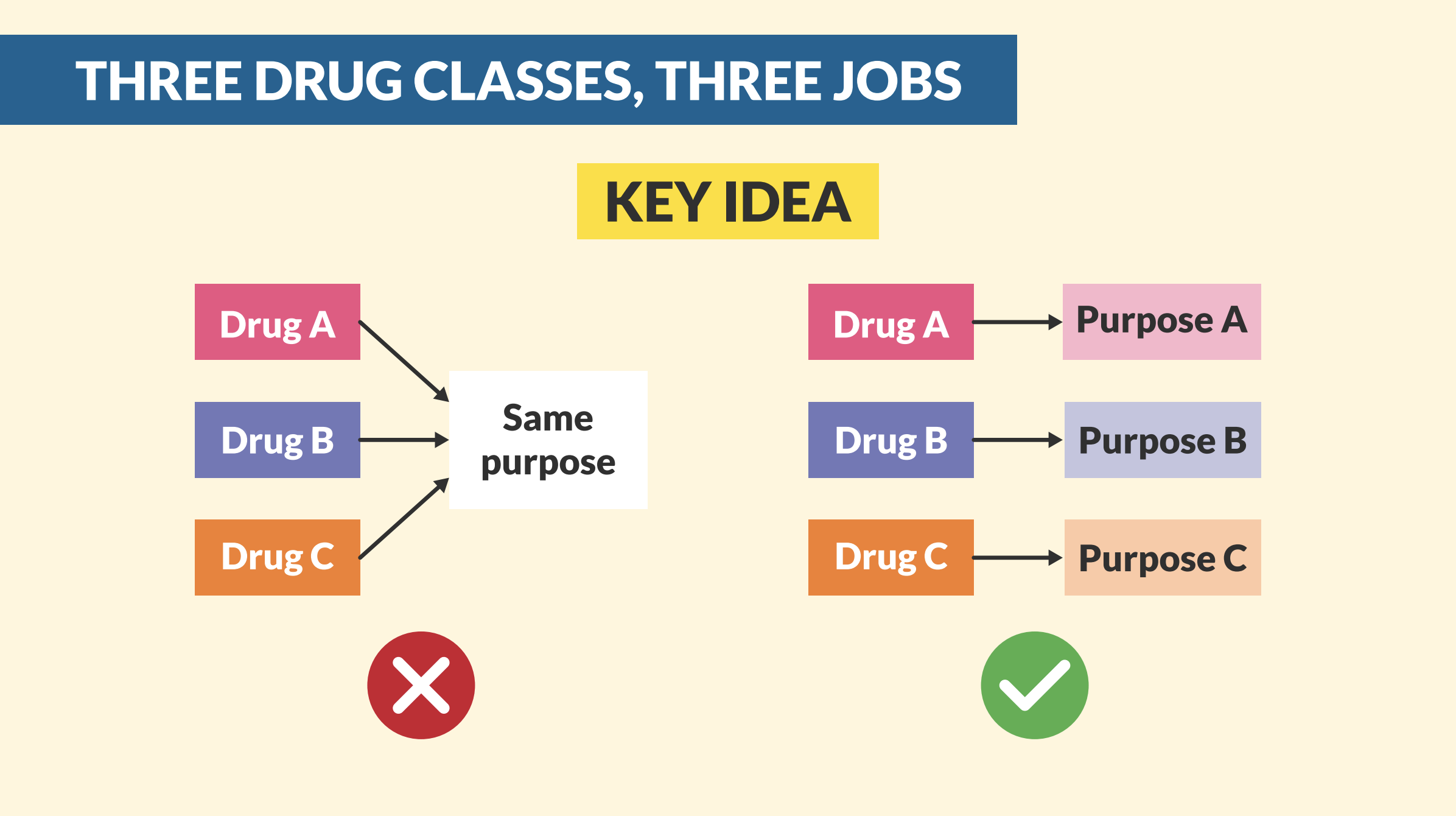
The same concept, as defined and as built. The marked moment is the distinction the exam tests and standard teaching rarely emphasises
Where this isn’t the right answer
If learners need volume of practice, a question bank does that better than anything we build, and we will usually recommend running both.
This work earns its cost when the same misconceptions appear across thousands of learners and adding more content isn’t fixing them.
What F.Learning does that a course provider usually doesn't
Almost all preparation material is organised around the syllabus, because the syllabus is what exists in writing. The exam is a different document, and it doesn’t always test what the syllabus emphasises.
So we read both. Which concepts get assessed every sitting and which are covered but rarely tested. Which questions require generating an answer rather than recognising one. How deep the understanding has to go to answer correctly, as opposed to deep enough to pick the right option when it is in front of you.
That gap decides the whole build. It is why two courses covering identical material produce different results, and why adding more content to a course that is already comprehensive usually changes nothing.
Two documents, rarely compared. The distance between them is where most preparation time gets spent badly.
Selected example
SimpleNursing: NCLEX-style exam prep at scale
A nursing education company needed learners to master dense medical and pharmacology concepts and apply them correctly under high-stakes exam conditions. Traditional lesson content felt heavy, hard to retain, and difficult to apply when questions framed the material in unfamiliar ways.
The series covers the distinctions nursing candidates most often confuse under exam pressure. One example is Heparin versus Warfarin: two anticoagulants with different uses, different monitoring, and different risks, where mixing them up in practice leads to serious dosing errors.
Reached 200,000+ learners
Social following grew past 500,000
600 minutes of exam prep animation delivered in 9 months
Result
SimpleNursing turned complex nursing concepts into a large, consistent library of visual exam-prep content, helping learners distinguish commonly confused concepts and recall the right information when working through NCLEX-style questions.
The platform now reports:
- 99% NCLEX pass rate among students who use the prep course (vs. ~69% national average in 2025
- Nursing school cohorts using SimpleNursing see 18%+ higher test scores on average and 12%+ lower attrition rates
The format also gave SimpleNursing a repeatable way to explain hundreds of high-stakes topics while keeping the learning experience consistent as the content library scaled.
Where this applies
- Academic subject learning: Foundational and advanced subjects where concepts connect across topics.
- Science education: Systems, mechanisms, and processes that are hard to grasp through text alone.
- Exam preparation: Timed, high-stakes assessments that test application rather than recognition.
- Professional certification: Dense technical material under limited study time and high career stakes.
- Concept mastery: Complex concepts that are easy to misunderstand or quickly forget.
- Continuing education: Retention, refreshers, and staying current rather than first-time learning.
Specific applications in each area
- Academic: STEM learning, higher education content
- Science: biology, chemistry and physics concept learning, mechanism-based explanation
- Exam prep: test prep, university entrance, certification exams
- Certification: PMP, IT certification, industry certification
- Concept mastery: complex concept explanation, knowledge reinforcement, retention
- Continuing education: lifelong learning, CPD, refreshers
Where your learners are losing marks, and what to build for each case
Different preparation problems need different design responses. Where the gap shows up decides what to build.
When concepts feel understood but don't hold up under exam questions
Concept architecture mapping (Content Structuring) | concept-driven training animation (Training & Education Animation) | visual communication systems (Documents & Graphic Design)
Best suited for dense technical subjects, concept-heavy syllabi, and any subject where learners can repeat a definition but struggle to apply it to a new scenario.
When learners consistently get a specific type of question wrong
Misconception-focused resources (Interactive Learning Design) | Targeted training animation & comparative concept visualization (Training & Education Animation)
Best suited for subjects with commonly confused concept pairs, predictable exam traps, and high-stakes certification or licensing exams with known difficulty patterns.
When learners need to apply knowledge, not just recall it
Interactive learning (Interactive Learning Design) | Retrieval-based activities (Content Structuring) | Scenario and case-based questions (Character Animation)
Best suited for application-heavy exams, clinical and technical licensing assessments, and any format that tests judgment rather than memorization.
When learners need ongoing recall support beyond the course itself
Study aids and visual references (Documents & Graphic Design) | modular revision content (Content Structuring)
Best suited for long syllabi, infrequent revision, and learners returning to a subject months after first studying it.
How F.Learning builds it: four steps, 6 to 10 weeks, starting with the exam rather than the syllabus
Step 1
Analyze the exam alongside the subject
Most preparation content is organized around the syllabus, which is what gets taught. We start by understanding what the exam actually tests, which can be different.
What this step covers
- The question types and formats the exam uses
- Which concepts are consistently tested, versus covered but rarely assessed
- How the exam expects learners to apply versus recall information
- The level of conceptual depth needed to answer correctly, versus to recognize correct options
Step 2
Build the concept architecture
Before any content is developed, we map how the subject’s concepts connect: what’s foundational, what depends on what, and what the mental model needs to look like for application to work.
What this step covers
- Identifying the core relationships and dependencies between concepts
- Separating must-understand principles from supporting detail
- Sequencing the explanation around how understanding actually forms, not syllabus order
Step 3
Surface and design around common misconceptions
Predictable misconceptions exist in almost every exam subject: the concept pairs learners consistently confuse, the question types that reliably produce errors, the principles that feel understood until applied to a novel scenario.
What this step covers
- The specific confusions that lead to wrong answers in this subject
- The explanations that feel clear but leave learners with incomplete models
- The tricky distinctions the exam tests that standard teaching doesn't emphasize
Step 4
Design practice for retrieval, not recognition
Study creates familiarity. Exams test retrieval. We design practice that builds the specific skill the exam requires.
What this step covers
- Questions that require generating answers, not selecting from options seen before
- Novel scenario framing that doesn't match the examples from the course
- Spaced practice that builds retention over time rather than cramming before the test
- Feedback that explains why, not just what was right or wrong
Related insight
More on leadership and manager capability:



Related services & solutions
Related Training Solutions
Related Services
Frequently asked questions
What types of exam preparation courses does F.Learning support?
How is visual exam preparation different from standard online courses or revision videos?
How do you handle subjects where concepts are highly technical or specialized?
Can exam prep content be adapted for different exam formats or learner levels?
How long does an exam preparation course development project typically take?
How much time will this take from our team?
For a typical academic or exam-prep project, plan for around 4-7 hours of SME time for the initial module or topic.
This usually includes 2-3 hours to align the syllabus with the exam and identify common learner misconceptions, plus 1-2 hours to validate the learning structure and explanations. Allow another 1-2 hours for review and final accuracy checks.
F.Learning handles the learning design and production between those stages.
What does an exam prep project cost, and how is it priced at volume?
For custom exam-prep content, a useful starting budget is around 5,000-15,000 per finished hour for low-to-mid interactivity, with highly interactive or simulation-heavy courses reaching 20,000-50,000+ per finished hour depending on subject complexity, learning design, practice content, and production format.
For larger course libraries, we typically price around the total number of finished content hours rather than treating every lesson as a separate project. This allows production to be standardized across the series and unit costs to become more efficient at higher volumes.
For an initial animation estimate, you can also use our Animation Cost Calculator.
Who owns the content after delivery, and can we resell it?
Your original content, knowledge, curriculum, policies, and materials provided to F.Learning remain yours. The final videos or course content produced and delivered as part of the project are also yours to use within the agreed scope.
F.Learning retains the intellectual property rights to the underlying production assets we create, including artwork, illustrations, storyboards, audio assets, and working files. If you need editable source files for future updates or adaptations, they can be included for an additional 10-30% of the project fee, depending on the files required.
If you plan to resell, license, or commercially distribute the finished content, let us know during scoping so the appropriate usage rights can be clearly agreed before production begins.
Can it be delivered in other languages or adapted for other markets?
Yes. Courses can be localized for different languages and markets, including narration, on-screen text, graphics, and supporting learning assets.
Where exams, terminology, or learner expectations differ by market, those versions can also be adapted rather than simply translated, using the same underlying concept architecture where appropriate.
Is the content accessible?
Accessibility requirements can be planned into the project from the start, including captions, transcripts, and supporting formats where required.
If your institution or platform works to a specific WCAG standard or internal accessibility requirement, define that during scoping so it can be included in the design and review criteria.

Pick the one subject where your completion rates and your pass rates disagree most. We'll read the exam against your syllabus and show you where the preparation time is going badly, before anyone talks about production.
30 minutes with a learning designer. No deck required.