Ready to master process mapping without the high cost of traditional workshops? Effective eLearning process mapping training replaces static slides with interactive modules that actually stick. To help you get started, we’ve compiled the definitive list of the 8 best free courses available in 2026.
Moreover, in this article, you’ll discover:
- 3 major flaws in traditional process mapping training,
- 4 ways eLearning makes complex workflows easier to grasp,
- And 1 powerful framework to upgrade your training without starting from scratch.
Let’s explore how to make your process training not just clearer – but smarter, faster, and future-ready.
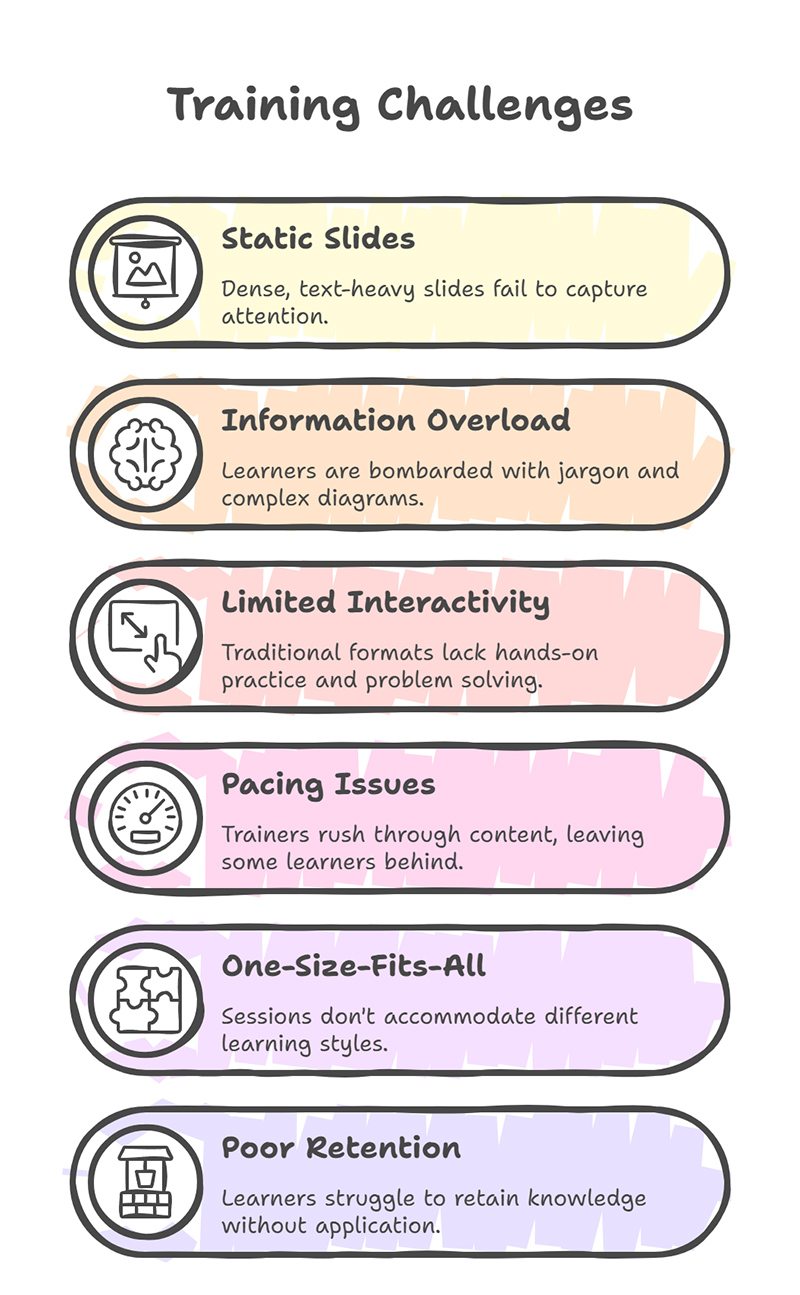
6 Common Challenges in Instructor-Led and Slide-Based Training
Relying on dense slides or lengthy workshops often leads to overwhelmed learners and missed opportunities for meaningful engagement. Let’s break down some of the most common challenges with these conventional training methods.
- Over Reliance on Static Slides: Training sessions often depend on dense, text-heavy slides that fail to capture learners’ attention or encourage active participation.
- Information Overload: Learners are bombarded with jargon, complex diagrams, and lengthy explanations, making it difficult to absorb key concepts.
- Limited Interactivity: Traditional formats rarely allow for hands-on practice, scenario-based learning, or real-time problem solving.
- Pacing Issues: Trainers may rush through content to cover everything within a set timeframe, leaving some learners behind.
- One-Size-Fits-All Approach: These sessions typically don’t accommodate different learning styles or individual paces, reducing overall training effectiveness.
- Poor Knowledge Retention: Without opportunities to apply knowledge in context, learners often struggle to retain what they’ve learned after the session ends.
Why These Issues Matter – and What They Cost
When employees misunderstand key processes, the impact ripples across teams. A missed step in a workflow can lead to delays, rework, or even compliance issues. A 2023 survey found that 42% of operational mistakes were linked to poor process understanding – often due to unclear training.
The cost isn’t just financial. It also slows onboarding, frustrates teams, and erodes performance. That’s why how you teach process mapping matters as much as what you teach.
Decision-Making Takeaway: If your current process mapping training relies on slides and lectures, it may be time to pause and ask: Is it truly working – or just checking a box? The good news? There’s a smarter, more scalable way. Let’s explore what eLearning brings to the table.
8 Free eLearning Courses for Process Mapping Training
Here’s a carefully researched list of real, free courses from reputable platforms-perfect for anyone looking to build or enhance their process mapping skills online:
| Course Title | Platform | What You’ll Learn | Level / Duration | Why It Stands Out |
| A Practical Guide for Process Mapping | Alison | Core process mapping symbols, draw.io basics, Microsoft PowerPoint use | Intermediate | Hands-on exercises and tool application |
| Process Mapping: Toolkit and Techniques | Alison | Lean Six Sigma approach, DMAIC integration, efficiency improvement | Business Management | Covers optimization frameworks beyond mapping |
| Process Mapping Technique: Time Value Maps (TVM) | Alison | Time Value Maps for identifying waste and streamlining workflows | Process Improvement | Focus on time-based efficiency analysis |
| Learn BPMN Process Mapping | GBTEC Academy | BPMN elements and modeling techniques | Beginner | Emphasizes industry-standard notation |
| Business Process Mapping | airSlate Academy | Workflow creation, mapping fundamentals, automation scenarios | ≈1 hour | Role-based modules and certificate included |
| Free Online Value Stream Mapping Training | DMAIC.com | Value stream mapping (Lean), bottleneck identification | ≈2 hours + template downloads | Practical Lean-focused workshop with certification |
| Business Analysis & Process Management Guided Project | Coursera (Guided Project) | Business analysis, process modeling on Lucidchart | Beginner to Intermediate | Hands-on, tool-based project with expert guidance |
| Introduction to Process Mapping | YouTube | Basics of flowcharts and value stream maps | Introductory | Free video overview, ideal for visual learners |
How to Choose the Right Course
| Use Case | Recommended Course |
| Learn mapping symbols & tools | Alison’s “Practical Guide” |
| Start Lean & process optimization | Alison’s “Toolkit & Techniques” or DMAIC |
| Master BPMN | GBTEC Academy |
| Tool-based hands-on practice | Coursera Guided Project |
| Quick visual overview | YouTube tutorials |
What eLearning Brings to Process Mapping Training
Modern eLearning solutions are transforming the way process mapping is taught and experienced. By replacing static materials with interactive, learner-centered content, organizations can boost engagement, understanding, and long-term retention.
Interactive Visuals That Simplify Complex Systems
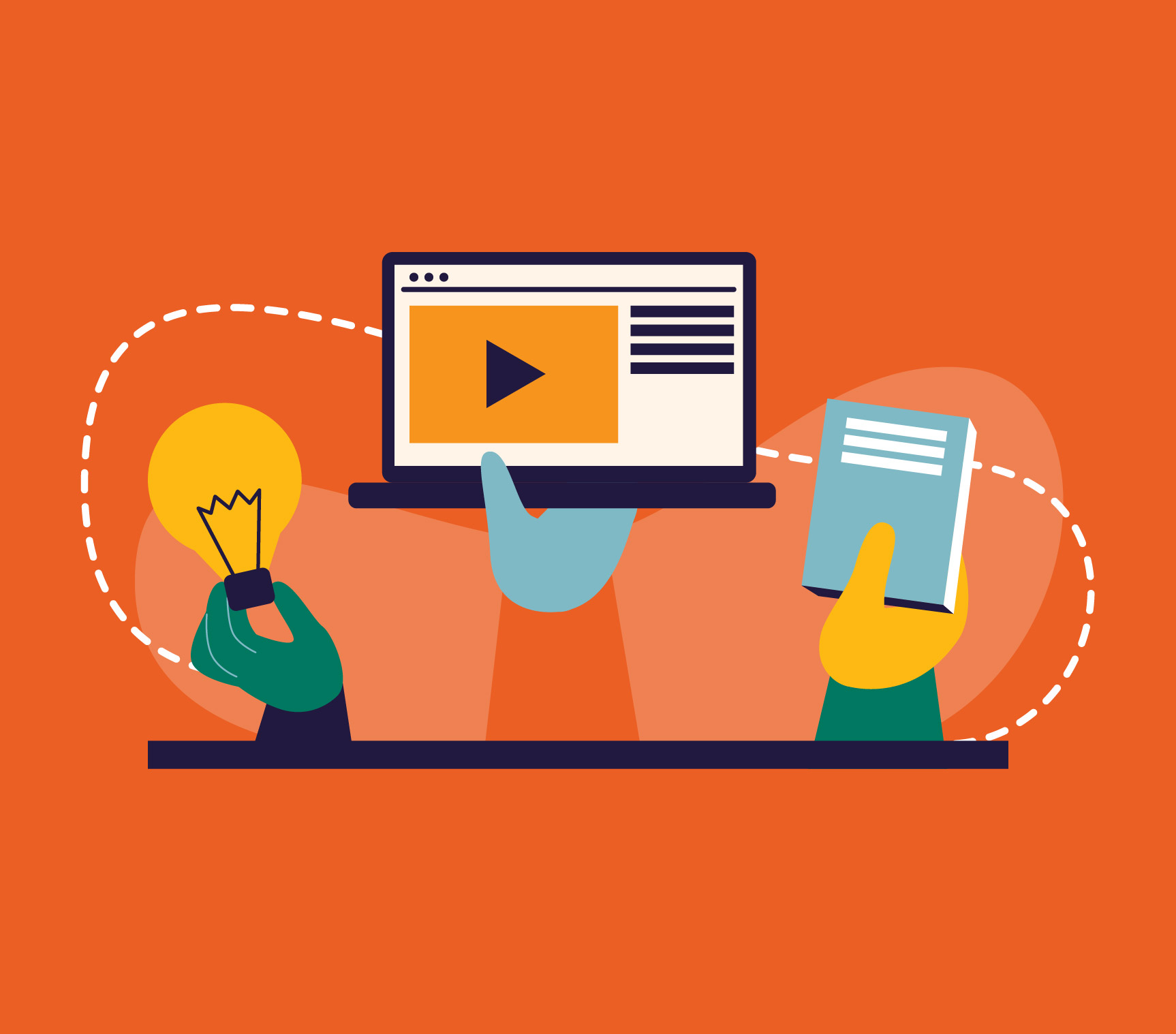
Process mapping is visual by nature – so why teach it in a static, text-heavy format? With eLearning, learners don’t just see the process, they can interact with it. Animated flows, clickable decision trees, and interactive simulations help learners grasp cause-and-effect, sequences, and dependencies far better than flat diagrams ever could.
Imagine a branching scenario where a learner clicks through a customer service process, choosing actions and immediately seeing consequences. That’s the kind of active engagement that builds true understanding.
Ready to stop showing processes and let your team interact with them?
Self-Paced Learning = Deeper Understanding
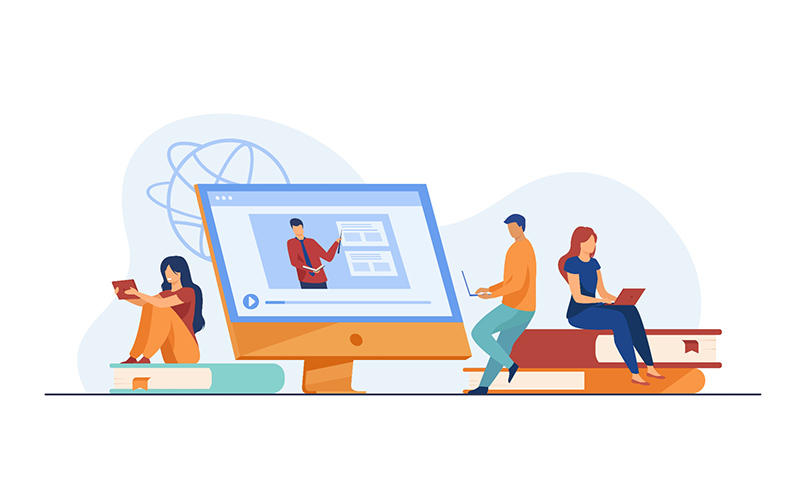
Not every learner digests process maps at the same speed. With eLearning, employees can pause, replay, and revisit tricky concepts as needed – without the pressure of keeping up with a live session.
This flexibility isn’t just convenient – it’s strategic. Studies show that self-paced training boosts retention by up to 25% compared to live sessions, especially for technical or procedural content.
Scalable & Update-Friendly Format
Processes evolve. Whether it’s a software update or a new compliance rule, training needs to keep up – fast. eLearning modules make that easy. Instead of scheduling another workshop or updating a giant slide deck, you can simply revise a segment of the course and re-publish it instantly.
For organizations with multiple teams, departments, or regions, that’s a game-changer. Everyone gets the same high-quality training – no matter when or where they learn.
Decision-Making Takeaway: eLearning doesn’t just replicate your current training. It transforms it into a more engaging, consistent, and future-proof experience – one that grows with your processes and empowers your people.
Real-World Examples – Turning Complex Engineering Diagrams into Engaging eLearning Content
Client: The University of New South Wales (UNSW)
Project: Electrical Engineering Online Course
UNSW needed a better way to teach circuit analysis – a foundational topic in electrical engineering that’s notoriously hard to visualize. Traditional methods relied on textbook diagrams and long lectures, leaving students overwhelmed and disengaged.
F.Learning Studio partnered with UNSW to transform this content into a series of short, animated videos. Our team handled all illustration and animation, working closely with subject matter experts to break down complex equations and circuit flows into simple, visual learning moments.
Each concept – from voltage laws to current direction – was brought to life with step-by-step animated breakdowns, creating clarity without oversimplification.
The result?
- Students could visually trace how electrical components interact, improving understanding and retention.
- The university saw a rise in positive feedback for the module, especially among visual learners.
- The video became part of a scalable library – reusable across cohorts, semesters, and course upgrades.
Clarity scales.
Confusion doesn’t.
Let’s turn your expert content into clear, engaging visuals - just like we did for UNSW!
Key Features to Look For in an Effective eLearning Solution
Clarity-Driven Design for Complex Topics
Not all eLearning is created equal – especially when it comes to explaining something as technical as process maps. Great eLearning design starts with visual clarity: clean layouts, simplified diagrams, and animations that unfold ideas step by step.
For example, instead of showing a massive spaghetti-like flowchart, a well-designed module reveals each branch progressively, with visual cues highlighting the logic behind decisions. This reduces cognitive load and improves learner focus.
At F.Learning Studio, we use a technique called “1 visual = 1 idea” to structure every scene. That way, learners absorb concepts in manageable pieces – not overwhelming chunks.
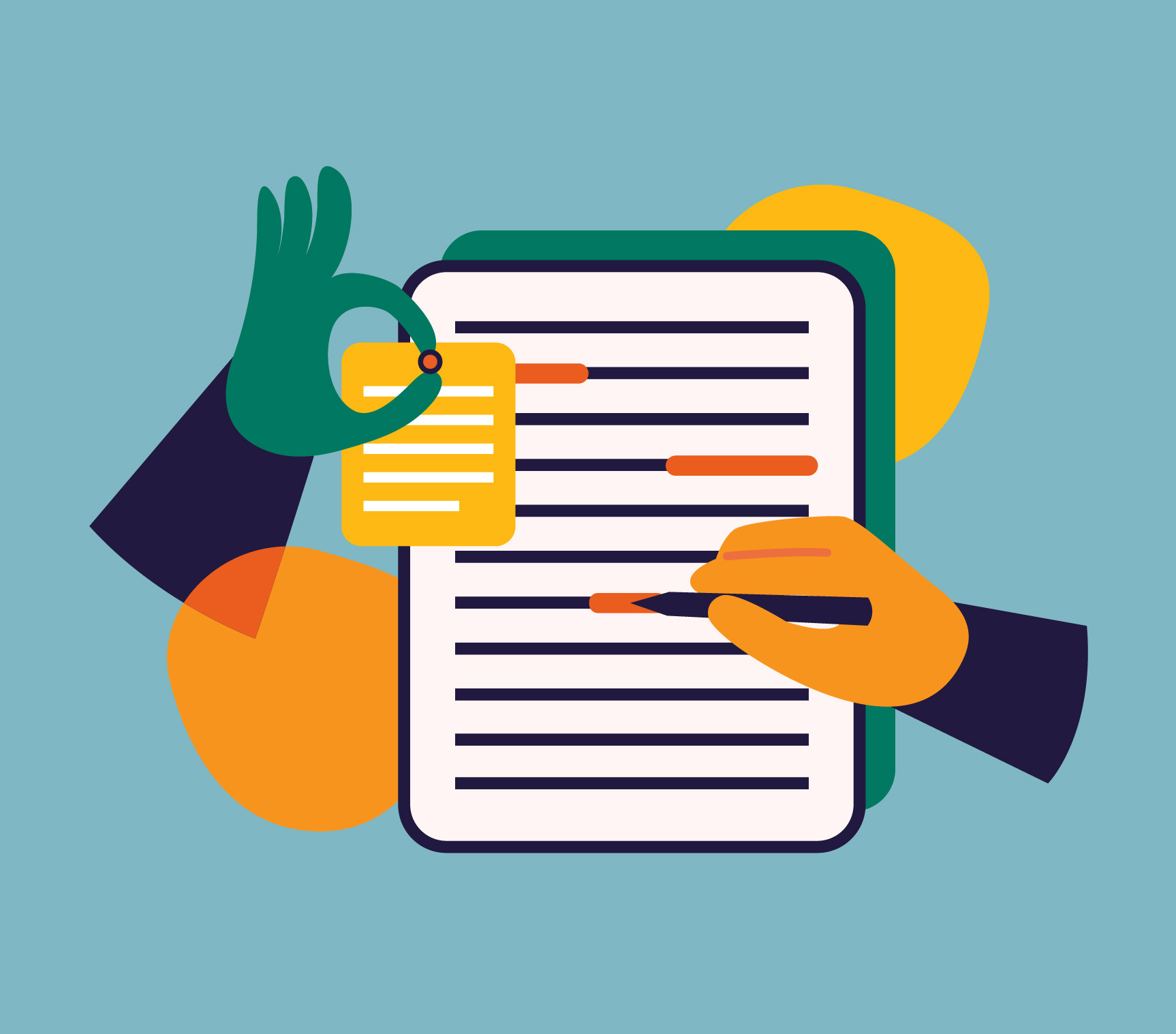
This clarity-driven approach is at the core of everything we do.
Want to see how the "1 visual = 1 idea" framework can simplify your most complex process?
Built-in Assessments and Feedback Loops
Learning isn’t complete until learners can test their understanding. Effective eLearning integrates quizzes, branching decisions, and real-time feedback – not just at the end, but throughout the experience.
For example, after teaching a subprocess (e.g., order approval), the module might ask:
“What would you do if Step 2 was skipped?”
By prompting learners to think through consequences, you reinforce learning and drive behavior change, not just recall.
Pro tip: Use scenario-based assessments instead of generic multiple choice. They’re more aligned with real-world execution.
Mobile-Ready and LMS-Compatible Delivery
Process training only works if people can access it easily. That means designing for multiple formats – desktop, tablet, or mobile – and integrating smoothly into your company’s LMS.
Your team should be able to:
- Track completion and scores,
- Assign modules to specific roles or departments,
- And update content quickly when the process changes.
That’s why F. Learning Studio ensures all modules are SCORM/xAPI compatible, mobile-responsive, and structured for quick iterations. It’s not just about accessibility – it’s about future-proofing.
Decision-Making Takeaway: If you’re investing in process mapping eLearning, make sure the solution goes beyond surface-level slides. Look for strategic design, real-time feedback, and seamless tech integration – otherwise, you’re just dressing up the same old problems in digital clothes.
How to Successfully Transition from ILT to eLearning
Start with the Process, Not the Slides
One of the biggest mistakes in transitioning to eLearning is trying to “convert” slide decks instead of redesigning the learning experience. Traditional workshops are often packed with explanations, detours, and discussions – but eLearning requires sharper focus.
Start by asking:
“What actions should learners be able to perform confidently after this course?”
Then build around those. Map each learning objective to a clear visual or interaction, not just content.
A good rule of thumb: no visuals = no clarity.
This ensures your course mirrors real-world logic, not a lecture script.
Ask your questions now & get answered
within 12 hours!
Partner with Experts Who Understand Learning Design + Process Thinking
eLearning isn’t just about knowing how to animate – it’s about knowing what to animate, and why.
At F. Learning Studio, we’ve helped teams turn vague workflows into clear, animated simulations that show the how and why of each step. That requires:
- Instructional design know-how
- Visual storytelling skills
- And a deep understanding of business processes
Look for partners who can ask smart questions, spot knowledge gaps, and design content that works for both learners and stakeholders.
Our team of instructional designers and animators live and breathe this stuff!
Pilot First, Then Scale
If you’re unsure how your audience will respond, don’t overhaul everything at once. Start with a high-impact process – one that’s either error-prone or frequently changing. Build a short module (5–10 minutes), gather feedback, and measure results.
This helps:
- De-risk your investment
- Get stakeholder buy-in faster
- And create internal champions who advocate for expansion
One of our clients piloted just one process – and after reducing errors by 30%, they rolled out 7 more modules in the same quarter.
Decision-Making Takeaway: You don’t need to digitize your entire training program overnight. Start small. Think strategically. And work with partners who understand that clarity drives performance.
Get the best values
for your project
See how much your project might cost at F.Learning Studio!
Ready to Rethink Your Process Mapping Training?
In today’s fast-paced workplace, it’s not enough to explain process maps and hope people remember. eLearning process mapping training makes concepts clearer, more consistent, and easier to apply in real situations. It’s the smarter way to boost quality, compliance, and operational efficiency. Whether you’re refreshing old materials or starting new, the right partner makes it simple.
📅 Book a free consultation with F.Learning Studio – and let’s turn your process mapping training into an engaging, visual experience.
You can also contact us via:
- Email: [email protected]
- Fanpage: https://www.facebook.com/f.learningstudio
- Website: https://flearningstudio.com/
- LinkedIn: https://www.linkedin.com/company/f-learning-studio/
Don’t stop here – keep reading to get more valuable insights:
- 3 Virtual Employee Engagement Ideas that Work in 2026
- eLearning Course Development: 8 Must-Know Steps in 2026
- Top 7 Explainer Video Script Writing Services for Your Project

Sean Bui, the founder and creative director of F. Learning Studio, is a respected leader in the e-learning and multimedia production industry.
With over 10 years of experience, he has dedicated his career to helping organizations create engaging and impactful learning experiences. Under his leadership, F.Learning Studio has grown into a trusted partner for organizations in the education, healthcare, and corporate training sectors, producing over 2,000 minutes of educational animation.
Sean’s expertise in translating complex concepts into compelling animated videos and interactive learning experiences, as well as his active involvement in the e-learning community, have earned him a reputation as a trusted partner and thought leader in the field of educational technology.