
Training & Education Animation
Training and education animation services for onboarding, compliance, and performance-critical learning
Most training gets completed. Much of it doesn't change what people actually do on the job. F.Learning helps organizations close that gap - building training animation around what learners need to recognize and do correctly, not just what information needs to be covered.
From onboarding and compliance training to leadership development and exam preparation, we help transform procedural and behavioral knowledge into visual explanations people can apply with confidence under real conditions.
Training animation requires more than animation skills
Training animation projects often involve challenges that don't exist in many other communication environments.
Workplace behavior is highly context-dependent - shaped by pressure, ambiguity, and decision-making that's difficult to script accurately. Audiences may include new hires learning a role for the first time, experienced staff who believe they already know the content, distributed teams who need identical understanding despite different shifts and locations, or compliance officers evaluating whether the explanation meets regulatory standards.
At the same time, training content often requires validation from L&D leads, subject matter experts, and operational stakeholders who each apply different criteria - instructional soundness, procedural accuracy, regulatory compliance - before training can be finalized.
Successful training animation therefore depends on more than visual execution alone. It requires balancing behavioral accuracy, audience readiness, organizational consistency, and real-world application throughout the development process.
Why organizations use training animation
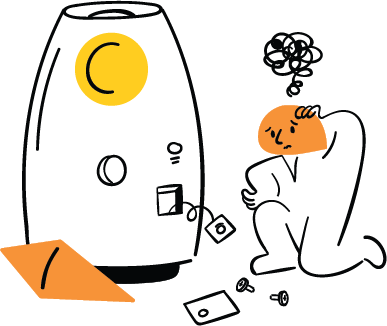
Many workplace topics involve decisions, behaviors, and situations that are difficult to teach through documents or lectures alone.
Correct procedure unfolds through a sequence of small decisions. Behavioral expectations - judgment, empathy, de-escalation - stay abstract until they're shown in context. Failure modes are easier to recognize when shown than to describe in a policy document.
Training animation helps make these intangible or hard-to-observe situations easier to teach by transforming them into visual scenarios audiences can see, recognize, and learn from.
When training needs to produce the same understanding consistently across new hires, distributed teams, or high-turnover roles, training animation often becomes one of the most effective tools available.
Beyond training delivery
Many training animation projects focus primarily on delivering content clearly. Clarity is essential.

The real problem:
But training communication often requires more than clear delivery alone. Learners need to recognize decision points, not just receive information. Teams need consistent behavior across shifts and locations, not just shared knowledge. Organizations need training that holds up when conditions are imperfect - not just when everything goes according to script.
Healthcare organizations need more than a visual explanation; training organizations need more than topic coverage. They need communication that supports recognition, decision-making, and real-world application.
The fixing:
This is where F.Learning takes a broader approach. Alongside animation production, we consider performance outcomes, decision architecture, organizational context, and real-world application - helping training become easier to retain and easier to apply.
By combining behavioral design thinking, learning design, and animation, we help organizations create training that does more than cover a topic. It helps people recognize, decide, and act correctly under real conditions.
Where training animation creates value

SOP & workflow training
Help employees understand standard operating procedures, workflows, and task sequences through clear visual demonstrations - improving consistency, accuracy, and process compliance. Common applications:
- Standard operating procedure (SOP) training
- Workflow and process training
- Equipment and operational procedures
- Quality assurance and process compliance

Compliance & Safety Training
Support consistent understanding of high-risk rules and procedures across teams, departments, and shifts. Common applications:
- Regulatory compliance education
- Workplace safety procedures
- Standard operating procedure (SOP) training
- Incident prevention training

Leadership & Soft Skills Training
Help managers and team leads recognize behavioral decision points and apply judgment in real workplace situations. Common applications:
- Management and leadership development
- Conflict resolution training
- Feedback and coaching skills
- Team communication training

Onboarding & Role-Based Training
Help new hires understand workflows, role expectations, and correct procedures before facing real tasks independently. Common applications:
- New hire onboarding
- Role-specific procedure training
- Workflow and systems training
- Cross-training for role transitions

Academic & Exam Preparation
Help learners understand underlying mechanisms and concepts rather than memorize facts - supporting application under exam or assessment conditions. Common applications:
- Certification exam preparation
- Concept-based learning modules
- Licensing and credentialing training
- Continuing education programs
Why training communication requires a different approach
Many animation projects focus primarily on storytelling, branding, or audience engagement. Training communication often requires additional considerations.
Audiences may be learning unfamiliar procedures, building judgment for high-pressure situations, or working toward measurable performance and compliance outcomes. As a result, training communication often places greater emphasis on behavioral accuracy, consistency, and real-world application.
| General Animation | Training Animation |
|---|---|
| Broad audience communication | Role-specific, performance-focused audiences |
| Creative interpretation | Behaviorally accurate scenarios |
| Marketing or creative review process | L&D, SME, and operational review process |
| Brand storytelling | Procedural and behavioral communication |
| General information | Job-specific and compliance-specific information |
| Audience engagement | Audience recognition and correct action |
This does not mean training animation needs to be less engaging. It means communication decisions must balance visual communication, audience needs, and behavioral accuracy throughout the project. That is why training animation projects often involve closer collaboration with L&D leads, subject matter experts, and operational stakeholders than traditional animation projects.
Training animation approaches
Different training goals require different animation approaches.

Procedural & workflow animation
Best for SOP training, compliance procedures, workflow communication, and step-by-step process explanation.
Scenario-based behavioral animation
Best for leadership training, soft skills development, customer interaction training, and decision-point practice.

Motion graphics & system visualization
Best for cybersecurity awareness, abstract systems, data flow explanation, and conceptual training content.
How F.Learning develops training animation
Training animation projects often begin long before visual production starts.

1. Understand the training challenge
We work with training managers, L&D leads, SMEs, and operational stakeholders to understand the audience, performance goals, behavioral complexity, and procedural requirements.
2. Structure the training explanation
Complex behavioral and procedural information is structured into clearer sequences - built around decision points and the failure patterns most likely to occur in real conditions.

3. Develop the training animation approach
Only after the explanation logic has been resolved do we develop the visual approach, scenario structure, and production assets needed to communicate it effectively.
4. Production, review, and refinement
Projects move through scripting, storyboarding, production, review, and refinement - with a strong focus on both behavioral accuracy and communication clarity.
Selected Examples
Integrity & Values Training Video
A scenario-based animation series helped managers understand and model integrity-driven behaviors in real workplace situations.
Simple Nursing NCLEX prep & nursing education
Animation helped Simple Nursing make complex nursing concepts easier to understand and more engaging, supporting growth to 200,000+ learners and 500,000+ social followers, with a 91% 5-star rating.






Mike Linares, RN, MSN

Shazia Adalat
Frequently Asked Questions
What training topics work best for animation?
Anything procedural, easy to misinterpret, or risky to get wrong - safety procedures, compliance behaviors, role-based workflows, and concepts that require seeing how something works rather than just reading about it.
When is training animation not the right choice?
When there's no defined correct behavior - topics genuinely open to interpretation where multiple outcomes are equally valid. Also when the primary goal is awareness or entertainment without a performance outcome attached.
Can you work with existing materials like slides, SOPs, or scripts?
Yes. Most projects start from existing content. We restructure it around the learning outcome - which often involves simplifying, reordering, and identifying what can be cut without losing what the learner actually needs.
How do you keep training accurate and consistent across teams?
We lock the must-understand points early - through the brief, script, and storyboard review stages - so visual interpretation can't introduce ambiguity before final delivery.
What if our training scope covers multiple topics?
We typically break it into a series, prioritizing the highest-risk or most commonly misunderstood areas first, then scale the approach in a way that maintains visual and structural consistency across modules.
Can the final assets be integrated into our LMS or onboarding system?
Yes. Deliverables are prepared for the specified deployment environment - LMS upload, SCORM packaging, onboarding platform integration, or standalone delivery.

If your teams are going through the motions but still making the same mistakes - the issue is usually how the training was designed, not how much of it there is.