

3D medical animation companies build anatomically accurate visualisations of things nobody can photograph: a device deploying inside an artery, a drug binding to a receptor, a surgical approach from an angle no camera can occupy. The nine studios below are the established specialists, and the section after them explains when 3D is genuinely necessary and when 2D or 2.5D will teach the same thing for a fraction of the budget.
Disclosure: this article is published by F. Learning Studio, which also produces medical animation and appears in its own section below. The nine companies in the main list are independent studios, profiled from public sources at the time of writing.
F. Learning Studio: Medical Animation in 2D, and Now in 3D
We should be straight about where we sit on this list, because it affects whether we are right for your project.
F. Learning Studio has produced healthcare and medical animation since 2016, for organisations including the NHS, NYU Langone Health, Stanford University, Evelina London Children’s Healthcare, and Boehringer Ingelheim. The depth of that work is in 2D: patient education, clinician and nurse training, and drug mechanism explainers.
Our 3D animation service is newer, and its published case work to date is scientific and product visualisation rather than clinical. We would rather say that than imply a 3D medical back catalogue we have not shown you.
What our 3D work currently looks like
The piece below was built for a keynote at The Electrochemical Society. The researchers already understood the individual technologies; what they could not see was how those technologies influenced each other inside one integrated system. Watch what the camera does rather than how it looks: it moves through the system to expose relationships between components, which is the same job a camera has to do inside an artery or around a device housing.
That project sits under science and complex information communication. The medical equivalent on our service page is Medical & Anatomical 3D, covering biological structures, clinical procedures, and mechanisms of action, for patient education, clinical training, surgical communication, and pharmaceutical MoA.
Why that combination may or may not suit you
- Choose a pure 3D medical house if your entire project is anatomical or molecular and nothing else. Several of the nine below have spent twenty years on exactly that.
- Choose us if your project is mostly 2D with a few passages that genuinely need three dimensions, such as a device mechanism inside a training course, or a surgical sequence inside a patient pathway. Specialist 3D studios rarely price that mix well, and running two suppliers across one script is where continuity breaks.
- Either way, ask for 3D samples specifically. That applies to us as much as to anyone below, and it is criterion six further down this page.
One process point worth knowing, because it is where medical 3D projects usually go wrong: on technical and scientific work we run subject-matter expert review at script, model, and animation stages, not only at delivery. Catching an anatomical error after a model is rigged and rendered is the single most expensive correction in 3D. Our production process sets out who signs off at each point.
Judge the output rather than the claim: browse our healthcare and medical work, filterable by format and industry.
9 Best 3D Medical Animation Companies
These nine are established 3D specialists. Scan the table first, then read the profiles for the two or three that match your subject matter.
| Company | Based in | Specialism | Notable clients |
| XVIVO | United States | Scientific and pharma visualisation, 20+ years | Pfizer, National Institutes of Health, Harvard University, Roche |
| AXS Studio | Toronto, Canada | Medical device and scientific animation | AstraZeneca, Bayer Healthcare, Pfizer, Nature |
| Ghost Productions | United States | Surgical animation and VR surgery | 4C Medical, AstraZeneca, Boston Children’s Hospital |
| Microverse Studio | United States | Mechanism of action and disease mechanism, since 2005 | Not published |
| 3D for Science | International | Medical VR, AR and interactive applications | Ogilvy Health, Thermo Fisher Scientific, Roche |
| DG Medical Animation | United States | Spine and orthopaedic animation, 3D focus since 2015 | Not published |
| Infographic World | New York, US | Medical and surgical animation plus graphic assets, since 2009 | WHO, California Department of Public Health, AmeriHealth |
| Austin Visuals | Texas, US | Orthopaedic, cardiovascular and neurosurgical procedures | Not published |
| Nucleus Medical Media | United States | Medical device, pharma and biotech animation | Nature, Boston Scientific, WHO |
1. XVIVO
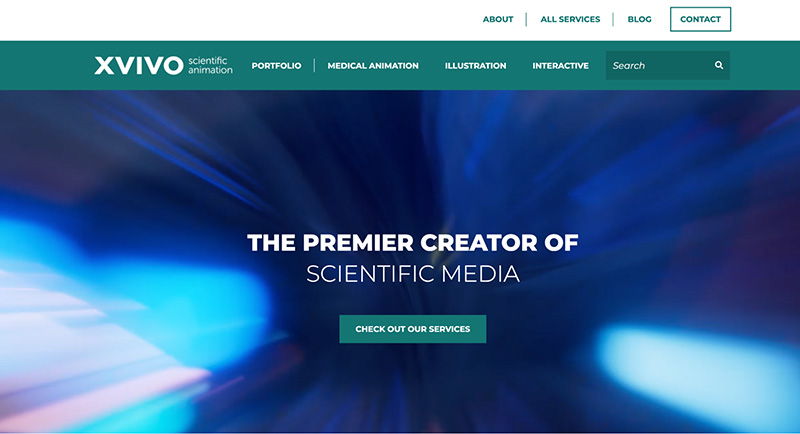
XVIVO is a 3D medical animation firm that has been operating for more than 20 years. They are experts at creating intricate and eye-catching medical visuals, animations, and interactive experiences that vividly depict cutting-edge scientific discoveries. XVIVO provides a wide range of services to its clients, such as research, authoring scripts, animation production, editing, and final delivery.
- Website: xvivo.com
- Services: 3D Animation, Medical Animation, Science Promotion, Medical Illustration, Pharma Marketing, Science Communication, Scientific Animation, Medical Advertising
- Experience and Testimonials: Their medical clients include Pfizer, the National Institutes of Health, Harvard University, and Roche.
2. AXS Studio
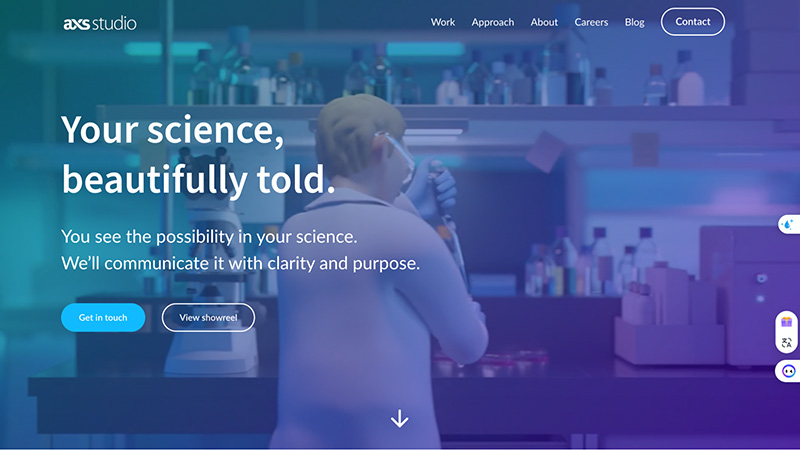
Based in Toronto, AXS Studio is a healthcare animation company that specializes in 3D medical animations. Their strongest areas of expertise are scientific and medical device animation, where they create captivating illustrations of intricate scientific ideas.
- Website: axs3d.com
- Services: Medical device animation, scientific animation, interactive experiences, illustrations
- Experience and Testimonials: They are the partner of leading healthcare agencies and medical communication companies such as AstraZeneca, Bayer Healthcare, Pfizer, and Nature.
3. Ghost Productions Medical Animation + VR Surgery
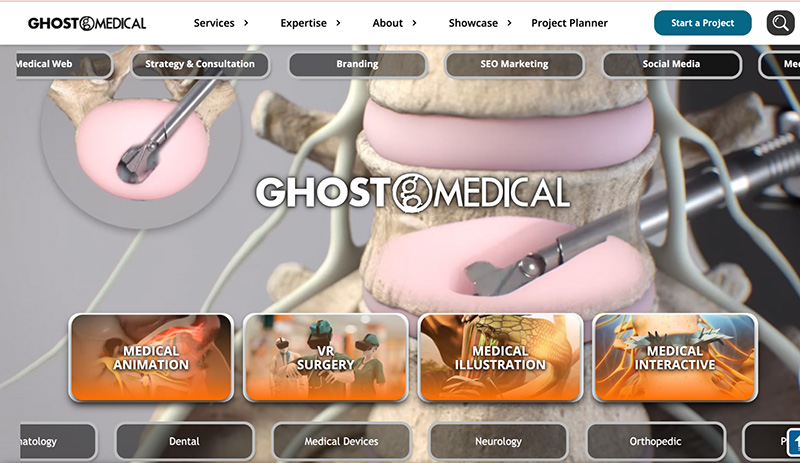
Ghost Productions is a US-based business that specializes in surgical and pharmaceutical 3D animations for the healthcare industry. The business is well known for producing top-notch surgical animations that are suitable for marketing and instructional uses. If your project is a surgical procedure specifically, this is the closest match on the list.
- Website: ghostproductions.com
- Services: Medical Animation, Patient Education, Interactive and Web Development, Illustration, Medical Devices, 3D Animation, Virtual Reality, VR Surgery, Surgical Simulation
- Experience and Testimonials: Ghost Productions has partnered with companies and organizations such as 4C Medical, AstraZeneca, and Boston Children’s Hospital.
4. Microverse Studio
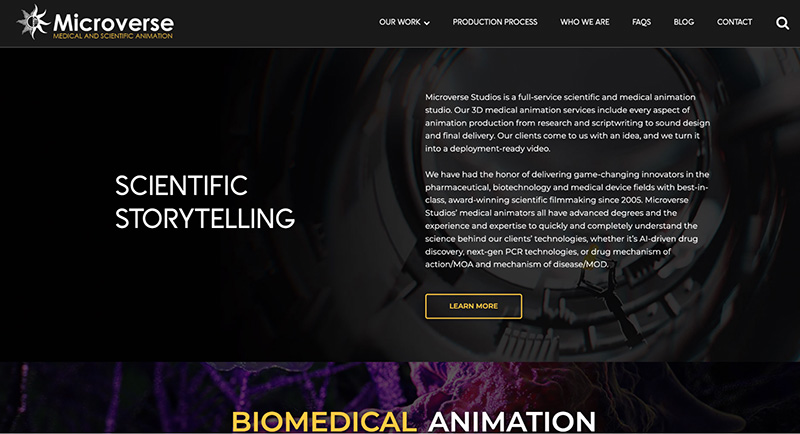
Microverse Studio is a full-service production company that has been creating high-quality scientific animations since 2005. The team’s scientific background allows them to comprehend their clients’ technologies and develop a seamless production process. They provide clients with the communication tools necessary to effectively explain technologies.
- Website: microversestudios.com
- Services: Pharmaceutical Animation, Mechanism of Action, Disease Mechanism, Explainer Video, Biotechnology Animation, Scientific Animation, Medical Animation
- Experience and Testimonials: Praised for extensive subject knowledge, engaging content, and professional working style. Client names are not published; ask for references in your therapeutic area.
5. 3D for Science
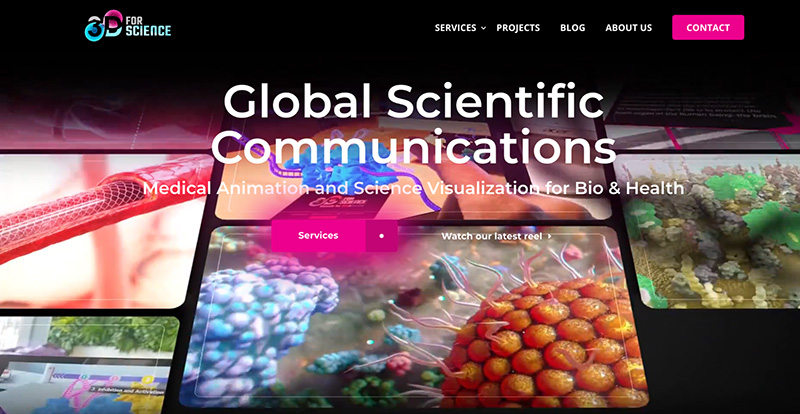
3D for Science provides virtual reality projects for training, education, and medical simulations. Virtual reality, web design, interactive applications, scientific illustration, and medical animation are among the areas in which they excel. Worth noting that a good deal of their output is interactive rather than linear video, so confirm the deliverable format early.
- Website: 3dforscience.com
- Services: Medical Animation, Scientific Illustration, Interactive Application, Virtual Space, Medical VR, Augmented Reality, Web Design
- Experience and Testimonials: They have worked with names such as Ogilvy Health, Thermo Fisher Scientific, and Roche.
6. DG Medical Animation
Dave Grossman established DG Medical Animations in 2002 as a division of DG Interactive, LLC. The business supported consumer product advertising from its founding, and since 2015 has focused on producing 3D medical animations, with spine and orthopaedic work its clearest specialism.
- Website: dgmedicalanimation.com
- Services: Product Marketing, Patient Education Videos, 3D Medical Animation for Physician Training, Spine and Orthopedic Animations
- Experience and Testimonials: This studio is well known for time management, high-quality animated video, and reasonable cost.
7. Infographic World

Infographic World (IGW), one of New York’s top medical animation studios, was founded in 2009. This firm specializes in producing medical videos, helping the medical community explain cutting-edge discoveries, treatments, procedures, devices, and pharmaceuticals. They also provide graphic asset development, marketing strategy, and digital strategy services.
- Website: infographicworld.com
- Services: Medical Animations, 3D Medical Animation, Surgical Animations, Scientific Animations
- Experience and Testimonials: IGW is trusted by organizations such as the WHO, the California Department of Public Health, and AmeriHealth.
8. Austin Visuals

Austin Visuals 3D Animation Studio is a Texas-based company that offers 3D, 2D, and virtual reality medical animation services. They educate medical experts and make complicated medical procedures easier for patients with their animations. Like us, they work across both 2D and 3D, which suits mixed-format projects.
- Website: austinvisuals.com
- Services: Orthopedic, Cardiovascular, Neurosurgical Procedures and Medical Device Animation
- Experience and Testimonials: Austin Visuals are prized highly for great-looking animation, cutting-edge technology, responsiveness, and pricing.
9. Nucleus Medical Media
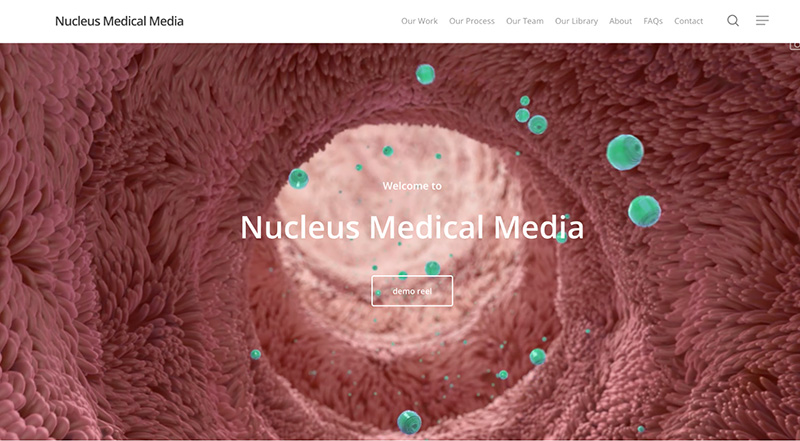
The primary focus of Nucleus Medical Media is developing visual solutions for a range of sectors, including healthcare, education, medical equipment, and pharmaceuticals. Their area of expertise is creating personalized animations and visuals that make difficult medical concepts understandable to all.
- Website: nucleusmedicalmedia.com
- Services: Medical Device Animation, Pharmaceutical and Biotechnology Animation, Medical Animation for Education
- Experience and Testimonials: The studio has won awards for its visual solutions, and is trusted by Nature, Boston Scientific, and the WHO.
Before you request nine quotes, get a number to hold them against
Enter your runtime, style and complexity and see where a project of your scope lands. Most studios above do not publish rates, so walking into those conversations with a benchmark changes what you can negotiate.
Open the animation cost calculator About two minutes. No email required to see the estimate.How to Choose the Right 3D Medical Animation Studio
1. Check their Portfolio and Track Record
The portfolio shows how much work the studio has completed and whether they hold both accuracy and visual quality. You do not need animation expertise to evaluate it: watch the videos and notice whether the camera actually reveals the mechanism, or whether it just moves around something that looks impressive. A strong track record with named clients and published feedback tells you the rest.
2. Examine their Expertise and Technological Capabilities
Experience is a key factor when selecting a medical animation studio for hire. Look at past projects across different niches to gauge proficiency, but do not focus on project count alone. What matters is whether the portfolio contains high-quality work that resembles what you need. Check too whether they use current software and rendering pipelines.

Read more: Medical Animation: A Complete Guide with 10 Examples in 2026
3. Explore the Range of Services
Check whether the studio handles the kinds of medical animation you need and has delivered projects similar to yours. A diverse portfolio spanning styles and complexity levels indicates versatility. Ask about process and timelines too: 3D medical projects commonly run eight to fourteen weeks, with the longest schedules on work requiring repeated expert review.
4. Look for Client References and Reviews
Once you have reviewed portfolios and spoken to the team, reviews from previous clients fill the remaining gap. Better still, ask to speak to a client with a brief like yours. A fifteen-minute call reveals what no case study will: how the studio handled a reviewer who changed their mind in week six.

5. Check the Price
Checking medical animation cost matters here more than in most categories, because 3D can run to a serious figure. A professional studio typically charges from $5,000 to $25,000 per finished minute, with complex anatomical or molecular work at the upper end.
Get itemised quotes and compare them carefully. The critical question is the unit: confirm whether you are being charged a fixed price for the whole project or a rate per finished minute, because the same headline number means very different things under each.
6. Ask to See 3D Specifically, Not Just Animation
This is the criterion that separates genuine 3D houses from studios listing 3D as a capability. Plenty of animation companies offer 3D and subcontract it, or deliver 2.5D work described as 3D. Ask for three things:
- A finished 3D piece with a moving camera that travels through or around a structure. Parallax on flat layers is 2.5D, which is a legitimate format but a different price and a different capability.
- Who builds the models, in-house or subcontracted, and whether the source is product specifications, scan data, or reference illustration.
- At which stages a subject-matter expert reviews. On 3D the answer needs to include the model stage, not just script and final cut. An anatomical error caught after rigging and rendering is the most expensive correction in the medium.
When 3D Is Worth It, and When 2D or 2.5D Is Enough
Once quotes arrive, 3D reveals itself as a significant investment of time, money, and review effort. That investment is justified in some cases and wasted in others, and the deciding question is not budget. It is whether your subject has meaningful geometry.
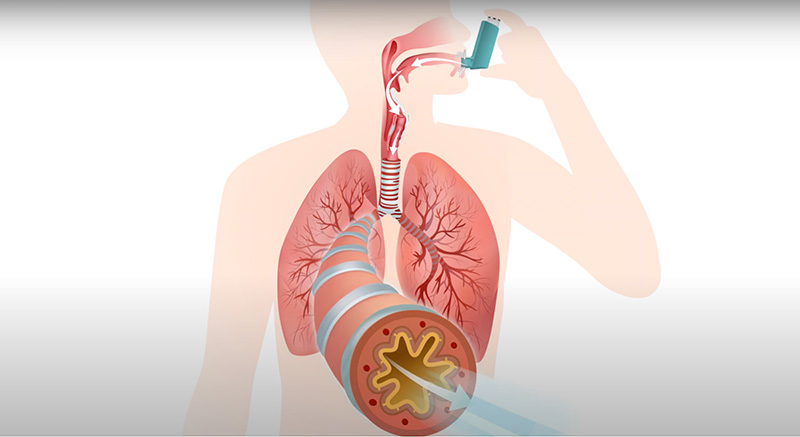
- 3D earns its cost when understanding depends on seeing inside or around something: a device mechanism, an anatomical structure, a surgical approach, a molecule binding. Flat illustration can label these; only 3D animation shows them accurately.
- 2D is the better choice when the subject is a process, a care pathway, a protocol, or a decision sequence. Forcing 3D onto a flowchart adds cost without adding comprehension, and a photoreal render of something conceptual can actively confuse.
- 2.5D sits between them, adding depth and perspective to layered 2D artwork without full modelling, rigging, and rendering. It is faster to produce and visually engaging, and often the right answer for patient-facing content that needs warmth rather than clinical precision.
Many medical projects need both within one script: 2D for the pathway and the patient story, 3D for the two minutes where the mechanism has to be exact. Scoping that mix at the start is considerably cheaper than commissioning it as two separate projects from two separate suppliers.
Where to Start
Work through it in this order: decide whether your subject genuinely has geometry, shortlist two or three studios whose published work matches your therapeutic area, then ask all six questions above on the first call, with question six carrying the most weight.
If your project is mostly 2D with passages that need 3D, or you are not yet certain which it is, that is the conversation F. Learning Studio is built for. We will tell you honestly if a specialist 3D house above is the better fit.
Not sure whether your project needs 3D at all?
Bring the condition, procedure or device, who has to understand it, and who signs off on accuracy. In 30 minutes you will get a recommendation on 2D, 2.5D or 3D with the reasoning written down, a scoped figure, and where expert review needs to sit in your timeline. If you would rather see it than discuss it, we will animate a short sample of your own subject at no cost.
Producing medical and healthcare animation since 2016 · 5.0 rating on Clutch · Trusted by the NHS, NYU Langone Health, Stanford University and Evelina London
- WhatsApp: (+84) 378 713 132
- Email: [email protected]
- Fanpage: https://www.facebook.com/f.learningstudio
- LinkedIn: https://www.linkedin.com/company/f-learning-studio/
FAQs
How much does 3D medical animation cost?
A professional studio typically charges $5,000 to $25,000 per finished minute, with complex anatomical and molecular work at the upper end. Cost is driven by the number of bespoke models, the level of detail required, runtime, and how many rounds of expert review happen after modelling has started. High-end work with extensive detailing and long runtimes can reach $100,000 or more.
How long does it take to create a 3D medical animation?
A basic 3D medical animation typically takes 4 to 6 weeks. More complex projects commonly run 8 to 14 weeks, with clinical and scientific work at the longer end because subject-matter expert review is built into the model and animation stages rather than only at delivery.
What is the process of making a 3D medical animation?
Ten stages: concept and planning, scriptwriting, storyboarding, modelling of anatomy and devices, texturing, animation, lighting and rendering, post-production, review and revision, and final delivery. The critical detail is where expert review sits. Catching an anatomical error after a model is rigged and rendered is the most expensive correction in the medium, so review belongs at script and model stage.
When should I choose 3D medical animation over 2D?
Choose 3D when understanding depends on seeing inside or around something: a device mechanism, an anatomical structure, a surgical approach, or a molecule binding. Choose 2D when the subject is a process, a care pathway, a protocol, or a decision sequence. Many medical projects need both within one script, with 2D carrying the pathway and 3D carrying the passages where the mechanism must be exact.
What is 2.5D medical animation?
2.5D adds depth and perspective to layered 2D artwork without full modelling, rigging, and rendering. It is faster and cheaper to produce than true 3D while still feeling dimensional, which makes it a common choice for patient-facing content that needs warmth rather than clinical precision. Confirm which you are being quoted, because 2.5D is sometimes described simply as 3D.
How do I check that a studio can genuinely produce 3D?
Ask for a finished piece with a camera that travels through or around a structure, rather than parallax on flat layers. Ask who builds the models and whether that work is in-house or subcontracted. And ask at which stages a subject-matter expert reviews: on 3D the answer needs to include the model stage, not just script and final cut.

Sean Bui, the founder and creative director of F. Learning Studio, is a respected leader in the e-learning and multimedia production industry.
With over 10 years of experience, he has dedicated his career to helping organizations create engaging and impactful learning experiences. Under his leadership, F.Learning Studio has grown into a trusted partner for organizations in the education, healthcare, and corporate training sectors, producing over 2,000 minutes of educational animation.
Sean’s expertise in translating complex concepts into compelling animated videos and interactive learning experiences, as well as his active involvement in the e-learning community, have earned him a reputation as a trusted partner and thought leader in the field of educational technology.