The main medical animation trends for 2026 are VR and AR training, personalised patient education, AI-assisted production, interactive 2D and 3D, time-based 4D visualisation, mobile-first formats, stronger compliance, reusable multi-audience assets, animation inside telehealth, and real-time surgical simulation. Each one changes what you should ask for in your next project.
The market behind them is growing quickly. Grand View Research estimates the global medical animation market at USD 472.2 million in 2024 and forecasts USD 1,418.7 million by 2030, a compound annual growth rate of 20.3% from 2025. This guide explains each trend, where it helps, the tools involved and what to watch out for, then covers the common challenges of adopting them.
Prefer to watch? This short video covers the healthcare communication trends behind many of the changes below.
Why Medical Animation Trends Matter
Grand View Research attributes the market’s growth to pharmaceutical marketing, patient education and advanced research, and reports that 3D animation held the largest share by type in 2024 (31.6%) and North America the largest regional share (46.3%). Other firms publish different totals: Precedence Research, for example, puts the global market at USD 511.59 million in 2025. The direction is consistent even where the numbers differ: more organisations are using animation to explain care, and expectations of quality and interactivity are rising.

10 Medical Animation Trends to Watch in 2026
| Trend | Where it helps most | Typical tools | Watch out for |
| 1. VR and AR integration | Surgical and procedural training, device demos | Unity, Unreal Engine, Vuforia, ARKit | Wow factor without a clear learning goal |
| 2. Personalised patient education | Chronic conditions, pre-op and discharge | Modular animation, patient portals, health apps | Handling patient data securely |
| 3. AI-assisted production | Drafts, voiceover, localisation, background art | Adobe Firefly, Runway, AI voice tools | Anatomical and clinical errors |
| 4. Interactive 2D and 3D | eLearning, patient apps, training modules | After Effects, Animate, Blender, Maya, Articulate, iSpring, Unity | Interactivity that adds clicks but not learning |
| 5. 4D (time-based) visualisation | Disease progression, healing, treatment response | Cinema 4D, Houdini, Maya | Implying precision the data cannot support |
| 6. Mobile-first formats | Patient education, frontline staff training | Responsive players, HTML5, vertical edits | Small text and labels that cannot be read |
| 7. Compliance and security | Anything using patient data or clinical trial content | Compliant storage, secure review platforms | Sharing drafts through unsecured channels |
| 8. Cross-disciplinary assets | Research, pharma marketing, training from one model | Blender, Maya, 3ds Max | One version that suits no audience well |
| 9. Animation in telehealth | Virtual consultations, remote follow-up | Video platforms, shareable clips | Large files on slow connections |
| 10. Real-time surgical simulation | Surgeon and theatre team training | Surgical simulators, Unity, VR platforms | Simulation without feedback to the learner |

1. Virtual Reality (VR) and Augmented Reality (AR) Integration
VR and AR place learners inside a procedure or let them see a device or organ overlaid on the real world, which makes spatial skills easier to practise. They work best for training that depends on hand position, sequence and spatial judgement.
Pro tip: define the learning or communication goal first. If a linear video teaches the same thing, the extra cost of VR is hard to justify.

2. Personalised Patient Education
Instead of one generic video, personalised patient education adapts animation to a patient’s condition, treatment stage or symptoms, usually by assembling modular scenes. Personalisation can also mean telling the story from the patient’s point of view. For Dr. Shin Shin Tang, F. Learning Studio created animation that shows real-life situations faced by young people with specific mental health symptoms, so viewers recognise their own experience. Dr. Tang was initially unsure animation suited such a serious topic, and later saw its value for connecting with patients.
Pro tip: build a library of reusable scenes and characters, then assemble versions for different conditions or stages instead of producing each from scratch.
3. AI-Assisted Production
AI tools now speed up parts of medical animation: draft scripts, background art, voiceover, translation and captioning. They do not understand anatomy or pharmacology, and generated visuals can contain errors that look convincing. The trend is AI-assisted production with human experts in control, not AI-generated medical content.
Pro tip: keep a qualified reviewer at script, storyboard and final cut, and check every AI-generated visual against reference anatomy.

4. Interactive 2D and 3D Animation
Interactive animation lets learners click on structures, choose a path or answer a question mid-video, which turns watching into doing. For iCareBetter, F. Learning Studio produced a series of whiteboard animations about heart failure that turned dense explanations into a clear, friendly format patients could follow. The medical whiteboard animation case study explains the approach, and our interactive learning design service covers adding quizzes and scenarios.
Pro tip: add interactivity only where it has a learning purpose, such as a hotspot on the structure people most often confuse, or a quiz at the point where mistakes happen.
5. 4D (Time-Based) Visualisation
4D adds time to 3D, showing how a process changes: a tumour growing, a fracture healing, a drug’s effect over weeks. Some 4D animation is built from time-resolved imaging such as 4D CT or MRI, which makes it valuable for both education and research communication.
Pro tip: label timescales clearly and avoid implying more precision than the underlying data supports.

6. Mobile-First Formats
Patients and frontline staff watch on phones, often with the sound off. Mobile-first animation uses large labels, captions, short scenes and sometimes vertical edits, and keeps file sizes small.
Pro tip: test on several devices and on a slow connection before release.

7. Compliance and Data Security
Most medical animations contain no patient data, but personalised education and clinical trial content can. When they do, rules such as HIPAA in the US and GDPR in Europe apply to how data is stored, shared and reviewed. Promotional pharma and device content also needs medical, legal and regulatory review.
Pro tip: use secure review platforms for drafts and agree who signs off before production starts.

8. Cross-Disciplinary Assets
One set of models or illustrations can serve researchers, clinicians, sales teams and patients if it is planned that way. Building modular segments up front lets you cut a scientific version, a training version and a patient version from the same assets.
Pro tip: agree the audiences at the start, so scenes are designed to be reused rather than retrofitted.
9. Animation in Telehealth
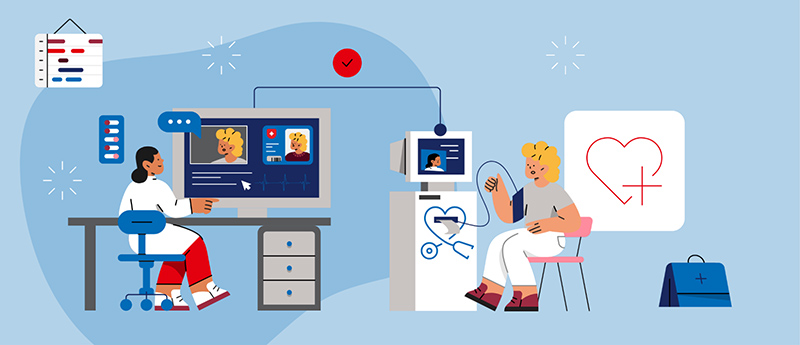
During a virtual consultation, a short animation shared on screen can explain a condition or procedure faster than words alone, and the patient can rewatch it afterwards.
Pro tip: keep clips short and light enough to stream smoothly on low-bandwidth connections.
10. Real-Time Surgical Simulation
Real-time simulations let surgeons and theatre teams rehearse procedures interactively, with the scene responding to their actions. See our surgery animation examples for how animation supports surgical training today.
Pro tip: pair simulation with feedback, such as scoring or debriefs, so learners know what to improve.
Want to see these formats in finished work? Browse our healthcare and medical animation, filterable by style and audience.
8 Challenges in Adopting Medical Animation Trends, and How to Overcome Them
| Challenge | How to overcome it |
| High production costs | Use modular, reusable assets; reserve VR and 3D for where they change outcomes; use AI for low-risk steps |
| Accuracy and compliance | Involve clinicians at script and storyboard; keep content updated; check privacy rules where patient data is used |
| Technical complexity | Start with a simple pilot, then scale; work with a specialist studio for new formats |
| Long development time | Use templates and modular scenes; prioritise the highest-impact topics first |
| Engagement and accessibility | Captions, mobile-first design, plain language, and feedback from real users |
| Data privacy and security | Encryption, secure review platforms, compliant cloud storage, regular audits |
| Resistance inside organisations | Show results from a pilot; train clinicians to use the content |
| Integration with existing systems | Use standard formats; involve IT early; choose solutions that fit your learning or patient platforms |
6 Ways Healthcare Teams Can Stay Ahead of Medical Animation Trends
- Start from the problem, such as a misunderstood procedure or a training error, not from the technology.
- Pilot one trend at a time on a single topic, and measure comprehension or behaviour before scaling.
- Build reusable assets so new formats such as interactive or mobile versions cost less to add later.
- Keep experts in the loop, especially when AI tools are part of production.
- Design for access first: captions, plain language and mobile playback reach more people than any new format.
- Review content regularly so it keeps pace with clinical guidelines.

Pricing a pilot before you commit?
Choose the style, length and complexity of a first video and see an estimate on screen, so you can scope a pilot that fits your budget.
Open the animation cost calculator About two minutes. No email required to see the estimate.Work with F. Learning Studio on Medical Animation
Animation Built Around Your Audience
F. Learning Studio has produced medical and healthcare animation since 2016, in 2D and now 3D. We adopt new formats where they help the audience understand, for example interactive versions of training content, and we use AI tools only for selected production steps, with every frame reviewed by people.

Case Study: IntelyCare
For IntelyCare, we produced branded 2D animation that breaks nursing procedures such as medication administration into clear, step-by-step visuals. According to the IntelyCare case study, the training programme helped attract 15,000 nursing professionals.

From Content Preparation to Finished Animation
We take projects from content structuring through script, design, animation and review, and keep the result simple for diverse audiences. You can start with a free consultation to clarify goals, or a free animation demo to see a sample of your own subject.

Streamlined Collaboration
Clients follow progress, comment and approve in shared review tools, which shortens feedback rounds and keeps projects moving. The clip below shows how feedback works during production.

Where to Start
You do not need every trend. Pick the one that solves your most expensive communication problem, whether that is a procedure staff get wrong or a condition patients misunderstand, and pilot it on one topic before scaling.
Want to try one of these trends on a real topic?
Bring the topic and the audience. In 30 minutes you will get a recommendation on format, from 2D to interactive or 3D, a scoped figure for a pilot, and where clinical review should sit.
Producing healthcare animation since 2016 · 5.0 rating on Clutch · Trusted by the NHS, IntelyCare and SimpleNursing
- WhatsApp: (+84) 378 713 132
- Email: [email protected]
- Fanpage: https://www.facebook.com/f.learningstudio
- LinkedIn: https://www.linkedin.com/company/f-learning-studio/
FAQs About Medical Animation Trends
What are the biggest medical animation trends in 2026?
VR and AR training, personalised patient education, AI-assisted production, interactive 2D and 3D, 4D time-based visualisation, mobile-first formats, stronger compliance and security, reusable multi-audience assets, animation inside telehealth, and real-time surgical simulation.
How big is the medical animation market?
Grand View Research estimates the global medical animation market at USD 472.2 million in 2024 and forecasts USD 1,418.7 million by 2030, growing 20.3% a year from 2025. Other research firms publish different totals, but all show strong growth.
Can AI create medical animations?
AI tools can speed up drafts, background art, voiceover and translation, but they do not guarantee anatomical or clinical accuracy. Medical animation made with AI still needs expert review at script, storyboard and final cut.
Is VR replacing traditional medical animation?
No. VR suits spatial, hands-on training such as surgical procedures, while linear 2D and 3D video remains the most practical format for patient education, explainers and most training. Many programmes use both.
How can a small team adopt medical animation trends?
Start with one topic and one trend, such as mobile-first patient education or interactive quizzes, measure comprehension, and reuse the assets as you scale. Captions and plain language deliver the most benefit for the least cost.
Read more:
- 3D Medical Animation: Uses, Benefits and Examples
- Top 10 Medical Animation Companies
- Interactive Patient Education
- Medical Animation Software Compared

Sean Bui, the founder and creative director of F. Learning Studio, is a respected leader in the e-learning and multimedia production industry.
With over 10 years of experience, he has dedicated his career to helping organizations create engaging and impactful learning experiences. Under his leadership, F.Learning Studio has grown into a trusted partner for organizations in the education, healthcare, and corporate training sectors, producing over 2,000 minutes of educational animation.
Sean’s expertise in translating complex concepts into compelling animated videos and interactive learning experiences, as well as his active involvement in the e-learning community, have earned him a reputation as a trusted partner and thought leader in the field of educational technology.