For a business project produced by a studio, 2D animation costs $1,000 to $15,000 per finished minute and 3D costs $3,000 to $25,000. Below that band, freelancers and DIY tools start near zero. Above it, feature-film studios pass $100,000 a minute.
That spread is not vagueness. It is the result of two different questions being answered at once: who you hire, and what you ask them to make. This guide separates the two, breaks down the 8 factors that move a quote inside any tier, explains how to read a per-minute price without getting caught out, and sets out where you can genuinely save.
If you want a figure for your own brief rather than a range, the animation cost calculator gives you one on screen in about two minutes, with no email required.
2D & 3D Animation Pricing Overview 2026
The tables below are organised by who produces the work. This is the axis that moves the price most: the same 60-second explainer can cost $300 or $30,000 depending only on who is holding the pen. Everything in this section is quoted per finished minute of animation, not per minute of work and not per project.
2D animation pricing
2D animation is a versatile and enduring art form that brings characters and stories to life through movement in a two-dimensional space. Below is a breakdown of typical pricing tiers for 2D animation in 2026, and what each level actually includes.
| Tier | Price range(per finished minute) | Description |
| DIY | $0 – $100 (depending on the package) | Utilize platforms like Powtoon or Animaker. Ideal for simple animations with limited customization and no professional guidance. |
| Freelancer | $300 – $3,000 | Independent animators offering varying quality. Suitable for basic to moderately complex projects; may require additional hires for scripting or VO. |
| Small studio | $1,000 – $5,000 | Teams providing end-to-end services, including scripting, storyboarding, and sound design. Good balance between quality and affordability. |
| Professional studio | $5,000 – $15,000 | Professional 2D animation studios offer end-to-end creative production with a strong emphasis on storytelling, design consistency, and brand alignment. These teams often include dedicated scriptwriters, storyboard artists, illustrators, and animators. |
| Movie production company | $15,000 – $100,000+ | Top-tier studios producing broadcast-quality animations. It involves extensive teams and advanced techniques and is suited for large-scale or cinematic projects. |
Want to see what animated videos look like at each level? The three examples below span the range:
The explainer below was made in Vyond with template characters and simple motion. It is squarely DIY-tier work, and it still lands the message. Worth watching to calibrate what the bottom of the market actually buys.
This piece, produced by F. Learning Studio for Story of Stuff, uses 2D character animation and narrative structure to explain how Coca-Cola became the world’s largest plastic polluter. Custom characters, custom backgrounds, original concept art: this is what the small-studio tier looks like.
“Paperman” by Walt Disney Animation Studios blends traditional 2D with computer-generated imagery. It sits at the movie-production tier and is included as a ceiling reference, not a benchmark: almost no business project needs or should pay for this level.
For a deeper breakdown of 2D pricing by vendor type: How Much Does 2D Animation Cost Per Minute?
3D animation pricing
3D animation adds depth and real geometry to visual storytelling. Because the pipeline includes modeling, rigging, texturing, lighting, and rendering before a single frame is animated, every tier sits above its 2D equivalent.
| Tier | Price range(per finished minute) | Description |
| DIY | $0 – $220 (depending on the package) | Utilize platforms like Blender or Animaker. Suitable for simple projects with limited customization and no professional support. |
| Freelancer | $500 – $3,000 | Freelance 3D animators are independent professionals who typically handle multiple aspects of production themselves. Best for small businesses or startups looking for affordable, entry-level 3D work such as product demos, simple character animations, or short visual effects. |
| Small studio | $3,000 – $10,000 | Teams providing end-to-end services, including modeling, rigging, and animation. |
| Professional studio | $8,000 – $25,000 | A professional 3D animation studio delivers a higher level of technical sophistication, visual depth, and production management. These studios typically offer full 3D pipelines: modeling, rigging, lighting, texturing, animation, and rendering. |
| Movie production company | $25,000 – $100,000+ | This is the highest level of 3D animation production, used for cinematic content, commercials, or large-scale storytelling. |
The example below shows character design and environment work at the upper end of the studio range. Watch the secondary motion: cloth, hair, and weight shifts are where 3D budgets disappear.
For the full 3D breakdown: 3D Animation Cost Per Minute: A Guide for Your Project 2026.
Which tier do you actually need?
Five tiers is useful for context and useless for deciding. In practice the choice comes down to three questions.
- Does the video carry your brand externally? If yes, DIY and most freelance work is out, because template assets make your organisation look like everyone else’s.
- Does it have to be accurate, not just clear? Technical, clinical, or regulated subjects need a team with a review step built into the process. That is the line between freelancer and studio.
- Is it one video or a series? Series economics change everything, because concept art and character rigs are built once and reused. A studio is often cheaper than a freelancer across five videos even though it is dearer across one.
Answer yes to any of the three and the small-studio tier is usually the efficient answer. That is the band F. Learning Studio operates in, and the calculator below prices your specific brief inside it.
Turn these ranges into one number
Pick your style, complexity, runtime and add-ons, and see where your project lands rather than where the industry sits. The estimate appears on screen, with a per-minute breakdown and a timeline in working days.
Open the animation cost calculator About two minutes. No email required to see the estimate.Key Factors Affecting the Cost of Animation
The tier you choose sets the band. These eight factors decide where inside it your quote lands, and the first three account for most of the movement.
1. Animation style
Style determines the complexity of the artwork, the tools required, and the skills involved, all of which feed straight into production time.
- A flat 2D motion graphic may need minimal frame-by-frame work and can reuse templated assets.
- A hand-drawn frame-by-frame piece, or a realistic 3D cinematic scene, demands far more labour, rendering time, and specialist input.
The table below cuts the market by style rather than by vendor, so the ranges are wider: each one spans freelance through professional-studio delivery of that style.
| Style | Typical Price Range(per finished minute) | Description |
| Whiteboard Animation | $1,000 – $5,000 | Simple line-drawn animations, often created with template-based software |
| Motion Graphics (Flat 2D) | $1,500 – $8,000 | Clean, minimal designs with icons and typography, ideal for explainer videos |
| Character-Based 2D Animation | $3,000 – $10,000 | Custom characters, frame-by-frame or rigged animation, strong storytelling |
| 3D Product Animation | $4,000 – $12,000 | Stylized or realistic rendering of products, often used in marketing and demos |
| 3D Character Animation | $10,000 – $30,000+ | Involves modeling, rigging, texturing, and character motion, often with voiceover |
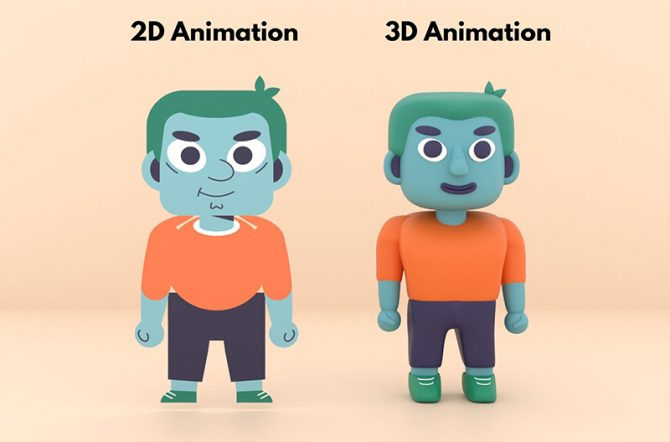
Not sure which style best conveys your message? Check out: 2D vs 3D Animation: Discovering 10 Key Differences
2. Video length
Longer videos need more scenes, assets, animation time, and rendering, so the total rises. The per-minute rate usually falls, though, because concept art, character rigs, and style frames are paid for once and then reused. The first minute is the most expensive minute you will ever buy.
The practical consequence: splitting one six-minute video into three two-minute modules costs almost nothing extra, and commissioning a series is meaningfully cheaper per minute than commissioning the same videos one at a time.
3. Complexity of the animation
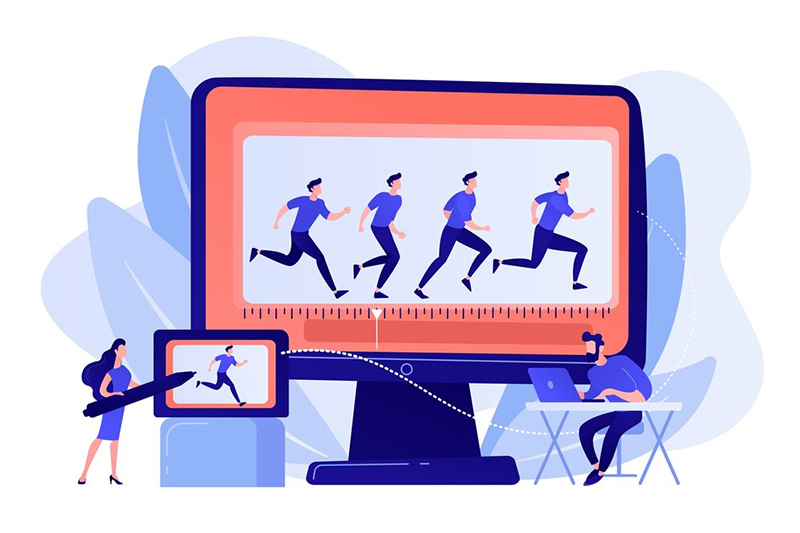
Complexity is usually the single biggest swing inside a quote. Dynamic camera moves, crowd scenes, realistic lighting, and fluid motion all multiply both labour and rendering time. Even in 2D, frame-by-frame animation costs more than rigged motion, and a character with facial expressions and custom clothing costs several times one built from basic shapes.
This is also the easiest place to overspend without gaining anything. Photoreal detail rarely improves comprehension in a training or explainer video; it just raises the invoice.
4. Voiceover & sound design
Professional voice talent, particularly in multiple languages or specific accents, adds to the budget, as do original music, licensed tracks, and sound effects. Studios often charge separately for casting, recording, and mixing.
Each additional language costs more than the translation itself: narration length changes between languages, so the animation has to be re-timed as well. Decide your language list before production starts, not after.
5. Production timeline
Tighter deadlines cost more. Rushing means reassigning people, extending hours, or adding resources, and studios price that in. A typical animation project runs 4 to 8 weeks or more, and compressing it raises both the invoice and the risk of errors reaching the final cut.
6. Revisions
Most studios include 1 to 2 rounds of revisions in base pricing. Beyond that, each round adds cost and delay, especially where script, voice, or animation changes are involved.
Where the revision falls matters more than how many you get. Changes at script and storyboard stage are effectively free. The same change after animation has started is paid for twice, once to build the original and once to rebuild it.
7. Location of the team
Animation is a people-hours business, so cost tracks salary levels. Studios in North America, Western Europe, and Australia charge considerably more than those in Southeast Asia, Eastern Europe, or Latin America, using the same software and often the same techniques.
Many Western studios outsource production to those same regions while keeping the client relationship and the creative direction. There are real reasons to pay the difference, including time zones, local contracting, and stakeholder handling. A difference in animation quality is rarely one of them.
8. Additional costs
Project management fees, licensing for stock assets, specialised plugins, cloud rendering, and software all sit outside the headline rate. Some studios also charge for strategy consulting, localisation, or accessibility work such as subtitles. Clarify what is in and what is out of any quote before you compare two of them.
How to Read a Per-Minute Price Without Getting Caught Out
Most disputes over animation budgets come from a unit mismatch rather than a disagreement about value. Three different things get quoted as “per minute”, and they are not comparable:
- Per finished minute. The industry standard, and what every figure on this page means. A five-minute video with a static title card and end frame may contain only four finished minutes.
- Per minute of runtime. Includes static frames, logo stings, and holds. A quote using this unit looks cheaper for the same delivered animation.
- Per project phase. Pre-production and post-production are often quoted as flat project costs, not per minute. Adding them to a per-minute rate produces a number that means nothing.
Before you compare two quotes, check that both state finished minutes, how many custom characters and backgrounds are included, how many revision rounds apply and at which stages, who writes the script, what the voice-over licence covers, and whether you receive the source files. A quote that is vague on those six points is not cheaper. It is the same price with the risk moved onto you.
Reasons Why Animation is so Expensive
There is a common perception that animation is “just drawing”. Behind every polished second is a layered, labour-intensive process involving design, direction, technology, and talent. Five things account for most of the cost:
- Highly skilled, multidisciplinary team: scriptwriters, illustrators, animators, voice artists, and sound designers, each an expert in one narrow craft.
- Time-intensive process: every second can involve dozens of frames, so even a short video takes weeks to reach professional polish.
- Custom artwork and design: characters, backgrounds, and assets are built from scratch to match your brand rather than pulled from a library.
- Complex production pipeline: scripting, storyboarding, illustration, animation, sound, and editing each hand off to the next, and a delay anywhere stalls everything downstream.
- Creative strategy and project management: concept development, messaging clarity, and the coordination that keeps a multi-specialist project on time and on brand.
Read more: 9 Reasons Why Animation is so Expensive: 8 Tips to Save in 2026
How to Calculate Your Animation Budget
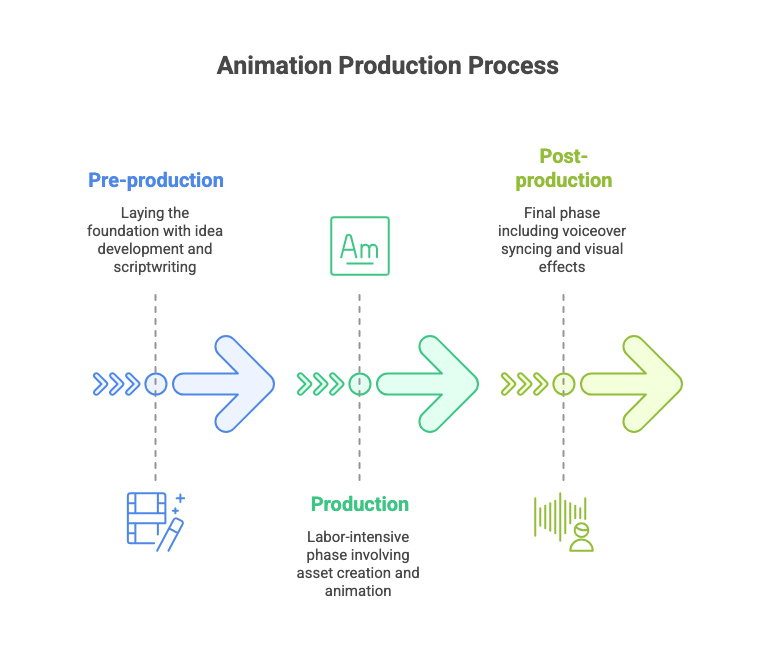
Per-minute rates tell you what animation costs. They do not tell you how your own budget breaks down. Splitting the project into three phases gives you something you can actually plan against, and shows where money is committed before any animation exists.
Pre-production
This phase shapes the story, message, and structure: idea development, scriptwriting, voice casting, and creative direction. It is the cheapest place to change your mind and the most expensive place to be vague, because every ambiguity left here resurfaces as a revision later.
Production
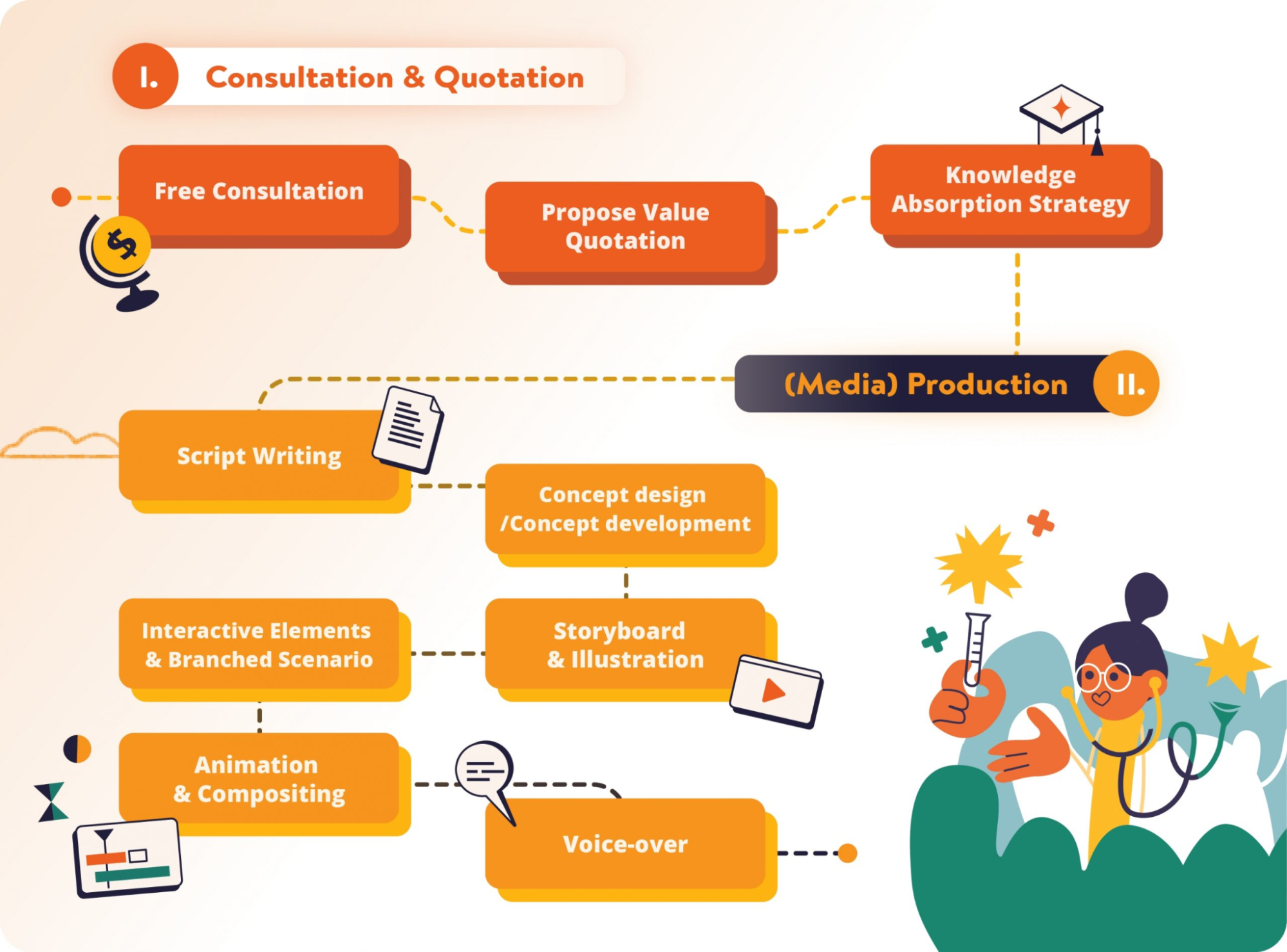
The most labour-intensive phase: styleframe development, storyboarding, asset creation (illustration or 3D modeling), rigging, and animation. Costs scale with style, complexity, and runtime. Our production process sets out who signs off at each stage.
Post-production
Voiceover syncing, sound design, transitions, visual effects, subtitles, and export. Less time-consuming than production, but it is what separates a video that feels finished from one that feels like a draft.
The figures below are project totals, not per-minute rates. Do not add them to a per-minute figure from the tables above; use them to sanity-check how a studio has split a single quote.
| Phase | Estimated project cost(2D animation) | Estimated project cost(3D animation) | Description |
| Pre-production | $1,000 – $3,000 | $2,000 – $4,000 | Includes concept development, scripting, voiceover casting, creative direction, and visual research. |
| Production and post-production | $2,000 – $10,000+ | $3,000 – $20,000+ | Covers styleframes, storyboards, design/illustration or 3D modeling, and full animation work. |
Numbers are easier to judge against finished work. Browse the F. Learning Studio portfolio to see what each style and complexity level actually looks like when delivered.
Tips to Save on Animated Video Production Costs
Animation is not cheap, but a good deal of what people spend is avoidable. Seven strategies that reduce cost without reducing quality:
Have a clear script and vision before production
The clearer your script and storyboard, the fewer costly revisions later. Define goals, tone, and message upfront so the creative team can execute rather than interpret. An approved script and a locked storyboard are the cheapest cost control available on any animation project.
Choose simpler animation styles
Complex visuals require more time, more specialised talent, and higher rendering costs. When clarity is the goal, a clean minimal 2D motion graphics style is usually just as effective and far cheaper. Spend the difference on a better script.
Reuse assets where possible
Reusing characters, backgrounds, icons, or transitions across scenes and videos cuts design time sharply. Ask your studio to build reusable templates that hold brand consistency while saving money on every subsequent video.
Limit revisions by giving clear feedback
Consolidate team input and send specific, structured feedback in one go. Scattered or contradictory revision requests are the most common source of overrun, and they cost you twice: once in fees, once in schedule.
Use royalty-free music and stock assets
Custom soundtracks and licensed visuals add cost that most viewers will never register. Good royalty-free music and stock footage lift production value without premium licensing fees. Check the licence covers your intended distribution before you commit.
Bundle multiple videos together
If you need a series, commission it as a batch. Studios discount bundled projects because concept art, character rigs, and style frames are built once and amortised across every video. This is the single largest saving available on this list.
Avoid last-minute changes
Changes to voiceover, timing, or visual direction in the final stages often mean redoing large sections. Get stakeholders to argue at storyboard stage, which is exactly what storyboard stage is for.
Looking for an Animation Expert? Partner with F. Learning Studio
F. Learning Studio has been producing animation for training, education, and healthcare since 2016, and operates in the small-studio band described above: full end-to-end production, custom concept art, and a named production manager, at Southeast Asian rates rather than Western agency rates.
Trusted by leading brands across healthcare, education, and corporate training
Clients include the NHS, NYU Langone Health, Stanford University, Evelina London Children’s Healthcare, King’s College London, Cornell University, UNSW Sydney, Boehringer Ingelheim, IntelyCare, Electrolux, ICRC, WWF, and Cengage. The studio holds a 5.0 rating on Clutch.
That range matters for a cost conversation more than it looks. A studio that has delivered clinical content, university curricula, and corporate onboarding has already solved the review cycles, accessibility requirements, and stakeholder sign-off patterns each of those brings, which is where budgets usually leak.

Scoped to one audience, not to a template
Every project starts by naming one primary audience and one thing they should be able to do afterwards. Tone, pacing, and design follow from that rather than from a house style, which is why the same studio produces calm patient explainers and fast-cut product films.
Affordable 2D animation without a thinner process
As a Vietnam-based studio, F. Learning Studio delivers custom animation at a price point that is difficult to match in North America or Western Europe for the same scope. The saving comes from where the team sits, not from cutting the concept art, the revision rounds, or the review steps.
Styles available run from whiteboard and motion graphics through character animation to frame-by-frame, so the style can be chosen for the audience rather than for the budget.
Where to Start
If you take one thing from this guide, take the two-layer structure: the tier you hire sets the band, and style, complexity, and revisions decide where inside it you land. Most overspending happens when someone buys a higher tier than their audience needs, or a lower one than their subject requires.
Ready to replace the range with a real number?
Bring your topic, your audience, and your runtime. In 30 minutes you will get a scoped figure with the assumptions written down, so you can hold any other quote against it. If you would rather see the work before discussing budget, we will animate a short sample of your own subject at no cost.
Producing educational animation since 2016 · 5.0 rating on Clutch · Trusted by NHS, NYU Langone Health, Stanford and Electrolux
- WhatsApp: (+84) 378 713 132
- Email: [email protected]
- Fanpage: https://www.facebook.com/f.learningstudio
- LinkedIn: https://www.linkedin.com/company/f-learning-studio/
FAQs
How much does animation cost per minute in 2026?
For a business project produced by a studio, 2D animation costs $1,000 to $15,000 per finished minute and 3D costs $3,000 to $25,000. Freelancers start around $300 for 2D and $500 for 3D, DIY tools sit below that, and feature-film studios exceed $100,000 per minute.
How much does a 1-minute animated video typically cost?
A 1-minute animated video typically costs $1,000 to $10,000 or more, depending on animation style, complexity, and whether it is produced by a freelancer, a studio, or an in-house team. The first minute is also the most expensive minute of any project, because concept art and character rigs are built once and paid for upfront.
How long does it take to produce a 1-minute animation?
It typically takes 3 to 6 weeks to produce a 1-minute animation, with timelines varying based on style, revisions, and production resources. A full project including several minutes of animation more commonly runs 4 to 8 weeks. Rushing that timeline raises both cost and the risk of errors reaching the final cut.
Does a longer animation cost less per minute?
Usually yes. Total cost rises with runtime, but concept art, character rigs, and style frames are paid for once and reused, so the per-minute rate falls. This is also why commissioning a series as a batch is meaningfully cheaper than commissioning the same videos one at a time.
What does per finished minute mean?
It means one minute of actual animation, not one minute of runtime. A five-minute video with a static title card and end frame may contain only four finished minutes. Some quotes use runtime instead, which makes the same delivered animation look cheaper, so confirm the unit before comparing two quotes.
What is the most budget-friendly way to create an animated video?
DIY tools such as Vyond, or a freelancer for basic 2D motion graphics, are the cheapest routes for short and simple videos. Neither includes scriptwriting, custom concept art, or a review step, so they suit internal content rather than anything that carries your brand externally or has to be technically accurate.
Can I get high-quality animation on a tight budget?
Yes. Choose a simpler style, lock the script and storyboard before production starts, reuse assets across videos, commission as a series rather than one at a time, and work with a studio based outside North America or Western Europe. Together these usually save more than cutting scope does.
What should I check before comparing two animation quotes?
Six things: whether the price is per finished minute or per minute of runtime, how many custom characters and backgrounds are included, how many revision rounds apply and at which stages, who writes the script, what the voice-over licence covers, and whether you receive the source files. A quote that is vague on these is not cheaper, it just moves the risk onto you.

Sean Bui, the founder and creative director of F. Learning Studio, is a respected leader in the e-learning and multimedia production industry.
With over 10 years of experience, he has dedicated his career to helping organizations create engaging and impactful learning experiences. Under his leadership, F.Learning Studio has grown into a trusted partner for organizations in the education, healthcare, and corporate training sectors, producing over 2,000 minutes of educational animation.
Sean’s expertise in translating complex concepts into compelling animated videos and interactive learning experiences, as well as his active involvement in the e-learning community, have earned him a reputation as a trusted partner and thought leader in the field of educational technology.