
Medical animation vs medical illustration is not a choice between a more advanced format and a simpler one. It is a choice between different ways of helping an audience understand medical information. Use animation when the central task involves movement, sequence, change, or an unseen process. Use illustration when the priority is a focused view of anatomy, structure, labeling, or a visual reference. This guide applies the topic identified in the Current activity Content Plan and turns it into a practical selection framework. The key question is straightforward: what must viewers understand, remember, or do after seeing the asset?
Medical Animation vs Medical Illustration: Choosing the Right Visual Format
The right format begins with the viewer’s understanding task, not with a preference for a particular visual style. If the message depends on sequence, transformation, or interaction, medical animation may provide the more suitable communication structure. If the message depends on examining a defined structure or returning to a visual reference, medical illustration may be the better starting point. This is a practical synthesis of the comparison topic selected in the Current activity Content Plan. Before commissioning either format, identify the audience, the message, the level of medical detail, and the action or understanding the asset should support. That short brief will make the eventual production discussion more focused. For examples of how animation can be used across healthcare contexts, review medical animation examples for healthcare content.

What Are Medical Animation and Medical Illustration?
A useful working definition of medical animation is a designed visual explanation that uses time, movement, or sequence to communicate a medical idea. A useful working definition of medical illustration is a designed static visual explanation that organizes anatomy, structure, relationships, or clinical detail for inspection. These definitions describe decision criteria for this guide rather than claiming that every project follows one format exclusively. Animation can include 2D, 3D, or other visual approaches, while illustration can range from a simple labeled diagram to a highly detailed anatomical reference. The difference between medical illustration and medical animation therefore concerns the communication mode as much as the appearance. Both may require a clear brief, medically appropriate content, and careful attention to the intended audience. The best choice depends on the understanding task.

Similarities Between Medical Animation and Medical Illustration
Medical animation and medical illustration can serve the same broad communication goal: making complex medical information easier for a defined audience to examine and understand. Both formats can be planned around anatomy, scientific concepts, procedures, treatment information, or educational messages. Both can also be adapted to different levels of prior knowledge, provided the visual brief defines what viewers need to take away. In practical terms, neither format should be selected only because it looks impressive. Each should support a specific message, use an appropriate level of detail, and avoid visual elements that distract from the learning task. Teams comparing medical animation services with medical illustration services can therefore begin with the same questions: Who is the audience? What is difficult to understand? What should the viewer do with the information? A shared brief creates a fair basis for comparison.
Key Differences Between Medical Animation and Medical Illustration
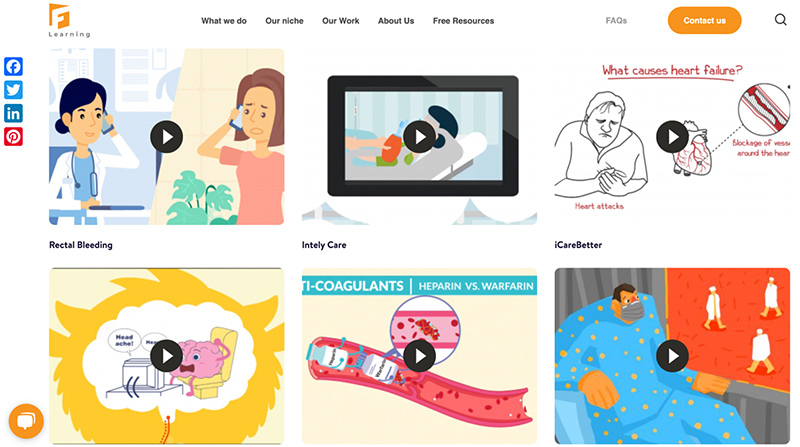
The central difference in medical animation vs medical illustration is how each format organizes attention. Animation is a practical fit when viewers need to follow an order of events, observe a change, or understand a process that is difficult to see directly. Illustration is a practical fit when viewers need to pause, inspect, compare, label, or revisit a defined structure. Animation may carry more time-based design decisions, while illustration may concentrate more attention on composition, labeling, and structural accuracy; these are planning considerations, not universal production rules. Audience needs also matter. A patient-facing explanation may require a carefully paced and reassuring visual sequence, while a professional reference may prioritize detail and quick inspection. A 3D medical animation can be considered when spatial relationships are central, but dimensional style alone does not determine whether the message will be clear. For a broader look at dimensional choices, see this 3D medical animation guide.

An Expert Decision Principle: Match the Format to the Understanding Task
A practical expert principle is to match the format to the understanding task rather than to visual novelty. Start by completing this sentence: “The viewer must understand how, where, why, or what.” “How” often points toward a sequence or process explanation; “where” or “what” may point toward a structural reference. “Why” may require either format, depending on whether the reasoning depends on change over time or on relationships shown in one view. Then test the draft concept against the audience’s prior knowledge, attention context, and expected next action. This approach keeps the format subordinate to communication purpose. It also prevents a team from treating animation as automatically more engaging or illustration as automatically too basic. The useful question is not which medium is more impressive, but which medium makes the intended idea easier to follow and apply.
When to Use Medical Animation or Medical Illustration
Choose medical animation when the project must guide viewers through a procedure, describe a biological sequence, reveal an unseen process, or show how parts relate as something changes. Choose medical illustration when the project needs an anatomy reference, a focused structural explanation, a labeled visual, or a still asset that viewers can inspect at their own pace. These are practical selection patterns, not fixed restrictions. A project may also combine both: animation can introduce a process, while illustrations can support review, labeling, or follow-up education. For instance, a pharmaceutical team explaining how a treatment moves through a defined pathway could use a short animation for the sequence and a companion illustration for the key structures. Reviewing medical animation applications in education can help a team compare possible use cases. The brief should still determine the final format.
Production Considerations: Scope, Detail, Audience, and Reusability
Production planning should examine scope, detail, audience, and reusability before a team commits to a format. For animation, define the required scenes, transitions, narration or on-screen text, and the level of motion needed to explain the idea. For illustration, define the view, labels, callouts, anatomical detail, and places where the image will appear. In both cases, specify who will see the asset and whether it must support patient education, professional communication, internal learning, or more than one context. Reusability should mean planned reuse, not simply keeping the source file. Ask whether the asset will need alternate crops, language versions, still extracts, or related materials. A service provider should be able to discuss these requirements before production begins. Teams considering animation can also review medical animation software considerations as part of their production conversation.
How to Choose Between Medical Animation and Medical Illustration
Use this short selection checklist before requesting a proposal. First, write the single idea viewers must understand. Second, mark whether that idea depends primarily on movement and sequence or on structure and inspection. Third, describe the audience’s prior knowledge and the context in which the asset will be viewed. Fourth, list the level of detail, required deliverables, anticipated reuse, and any review needs. Finally, ask prospective partners to explain why their recommended format fits the understanding task. A simple example: if a patient must follow the stages of a procedure, begin by testing an animation concept; if a clinician must examine and label a specific anatomical relationship, begin by testing an illustration concept. If the choice remains unclear, discuss the brief with a qualified medical animation or medical illustration partner. Patient education strategies can provide additional context for audience-centered planning.
Conclusion
Medical animation is strongest when viewers need to follow movement, sequence, or an unseen process. Medical illustration is strongest when they need a focused structural reference that can be inspected and revisited. Neither format is automatically the better investment. The decision should follow the message, audience, level of detail, viewing context, and intended action. Start with the understanding task, then choose the visual system that supports it with the least unnecessary complexity. For healthcare and pharmaceutical teams, a focused project conversation can clarify whether animation, illustration, or a combination will communicate the intended idea most effectively.