
Every year, millions of international tourists visit Vietnam. Most of them know, in some general sense, that buying ivory is wrong. Yet ivory products continue to sell – as souvenirs, gifts, status symbols – in shops that tourists walk into voluntarily.
WWF Vietnam launched a public awareness campaign targeting this exact gap. They came to F.Learning with a clear goal: produce a set of Public Service Announcements (30- and 60-second versions) strong enough to deter ivory purchases among tourists, involve travel service providers, and reinforce that ivory trade in Vietnam is a serious crime.
The goal was clear. But the real question was: why does a message that everyone already agrees with keep failing to change behavior?
Knowing Something Is Wrong Isn’t the Same as Seeing How You’re Part of It
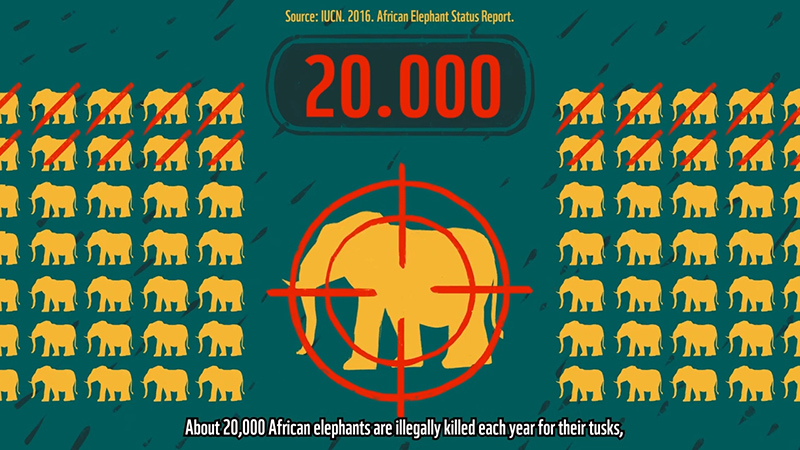
The standard approach to anti-ivory messaging relies on information: the numbers are devastating, the laws are real, the consequences are severe. Between 2010 and 2018, an estimated 157,000 elephants were killed for their tusks. Populations have dropped from over 1.3 million in the 1970s to roughly 400,000 today. After China’s 2017 ivory ban, demand didn’t disappear – it shifted to overseas markets, including Vietnam.
None of this information is hidden. Tourists have seen the headlines. They’d agree, if asked, that ivory trade is a crisis.
But in the moment that matters – standing in a shop, browsing what looks like an ordinary souvenir – that knowledge doesn’t activate. The object on the shelf feels disconnected from the elephant that was killed. The purchase feels small, personal, harmless. The crisis feels distant, systemic, someone else’s problem.
This is what happens when people understand a problem in the abstract but can’t see the mechanism that connects their own actions to it. The understanding feels complete, but the link between “I’m buying a souvenir” and “an elephant was killed for this” remains invisible.

Making the Invisible Chain Visible
F.Learning built the PSA around one structural decision: start where the tourist actually is, then reveal what they can’t see from there.
The video opens with a scene any traveler would recognize – browsing a souvenir shop, picking up an item, considering a purchase. No statistics. No warnings. Just a familiar, everyday moment.
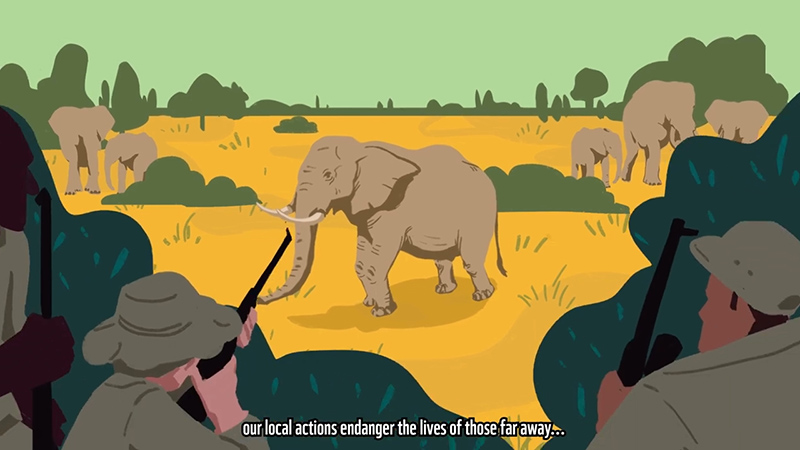
Then the animation pulls back, showing what’s behind the object on the shelf. The hand-drawn style wasn’t chosen for aesthetic warmth – it allowed the PSA to show the reality of elephant poaching in a way that felt human and direct rather than sensationalized. Rough strokes and organic lines carried the weight of what polished graphics would have sanitized.
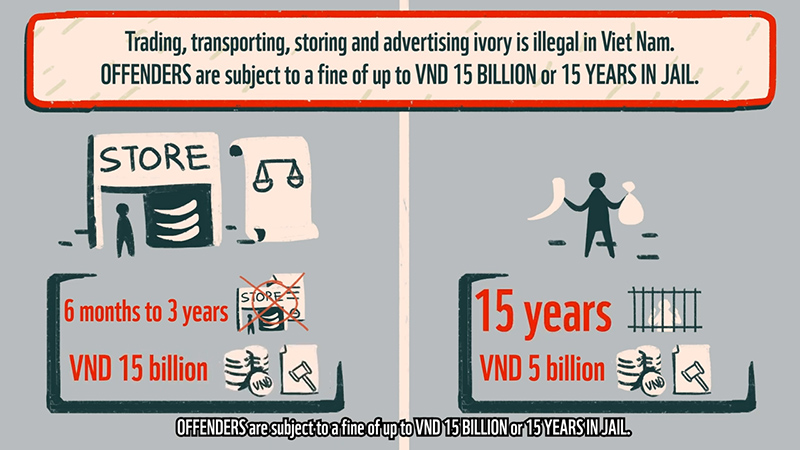
By the time the legal consequences appear – real penalties, real enforcement – the viewer has already made the connection. The law isn’t abstract policy anymore. It’s the consequence of the action they just imagined themselves taking.
Reaching People at the Point of Decision
Distribution followed the same logic. The PSA was placed in hotel lobbies, airport lounges, taxis, and public transport hubs – not because those are high-traffic locations, but because they’re where tourists are closest to making the purchase the video is designed to prevent. The explanation met people at the moment it mattered most.
What This Campaign Changed
WWF Vietnam needed a PSA that worked harder than a warning. What F.Learning delivered was an explanation that closed the gap between abstract agreement and personal responsibility – so that the next time a tourist stands in a shop, the connection between the souvenir and its cost is no longer invisible.