
When people get things wrong, you lose time, money, and sometimes safety
Most costly mistakes caused by misunderstanding, forgetting, or misinterpreting critical information don’t just slow teams down
They lead to compliance failures, lost revenue, safety incidents, and legal risk across training, communication, and healthcare.
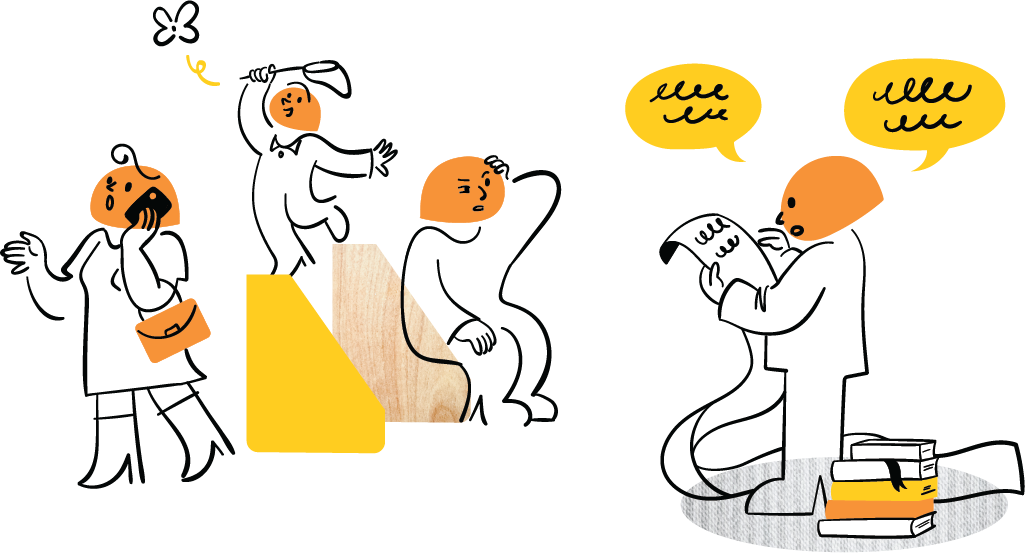
This problem shows up in:
What Is Really Going Wrong?
Most organizations don’t suffer from a lack of information. They suffer from information that is misunderstood, forgotten, or applied incorrectly, especially under time pressure.
This shows up as:

Employees skipping or misapplying procedures
Sales teams explaining products differently across regions
Customers using products the wrong way
Patients' misunderstanding of instructions or care steps
Audits, incidents, or errors that “should never have happened.”
The root cause isn’t people. It’s how critical knowledge is delivered: unclear, too dense, easy to forget, and hard to apply in real situations.
Process Overview
You bring the challenge. We shape the solution. Here’s how we make the process easy, even without a full brief.

Reduce costly & risky mistakes
Errors caused by misunderstanding often surface at the exact moment precision matters most - during audits, procedures, or critical decisions.
Clear instructions don’t always lead to correct interpretation. When people rely on memory or personal judgment instead of shared references, small gaps quickly turn into costly errors.
- Instructions are interpreted differently
- Correct steps are missed or improvised
Reduce time-to-productivity
New hires, partners, and users often take too long to perform — not because they lack training, but because knowledge doesn’t translate into independent action.
Learning happens upfront, but performance is expected later - without enough support at the moment of real work.
- Long ramp-up despite completed training
- Repeated questions and reliance on others
Prevent revenue loss from product misunderstanding
Deals stall, adoption drops, and support costs rise when complex products or services aren’t understood the same way by everyone involved.
People build different mental models of the same product, even when explanations exist.
- Misalignment between sales, marketing, and users
- Customers misunderstanding value or usage
Improve adoption & reduce misuse
Tools, systems, and processes fail when people don’t fully understand how to use them correctly.
Understanding concepts doesn’t guarantee correct application. Without guidance in context, people adapt tools in unintended ways.
- Partial adoption of features or processes
- Workarounds replacing intended use
Master complex, high-stakes knowledge
In healthcare, science, and regulated environments, information is delivered — but confidence in applying it correctly is often missing.
Complex knowledge requires judgment, not memorization. Without clear mental models, people hesitate or apply rules inconsistently.
- Low confidence in real decision-making
- Errors increase as complexity rises
Why Information Delivery Alone Isn’t Enough
Most approaches focus on delivering information, not ensuring understanding.
But for these outcomes to be achieved:
People must see what right looks like.
Decisions improve when they’re practiced in context.
Memory needs anchors at the moment of action.
That’s where visuals come in, not as decoration, but as mechanisms that create:
Clarity instead of interpretation
Shared understanding instead of assumptions
Recall under pressure instead of forgotten rules
Consistency across roles, teams, and audiences
How This Connects to Our Solution
Critical knowledge needs to be delivered in a way people can understand fast, remember longer, and apply correctly in real moments. That's why we address it through three connected solution areas:
Training solutions
Helping people learn faster, remember under pressure, and act correctly in real work.
Product & communication solutions
Aligning understanding of complex products, services, and systems across teams and markets.
Healthcare solutions
Reducing risk and misunderstanding where clarity directly affects safety and outcomes.
How These Outcomes Are Delivered
These outcomes show up across training, communication, and healthcare, but they’re delivered through a small set of focused capabilities:
Deciding what needs to be explained, in what order, and at what level of detail, so the message stays clear, focused, and easy to apply.
Turning complex knowledge into clear, consistent visual explanation.

Deciding what needs to be explained, in what order, and at what level of detail.
Helping people practice decisions in context so the right action becomes natural.
Creating quick-reference visuals that support correct action at the moment it’s needed.
FAQs
1. Why does clear information still lead to mistakes?
Because “clear to read” isn’t the same as “clear to act.” Under time pressure, people rely on quick cues, not long explanations.
2. Why doesn’t training automatically change behavior?
Completion isn’t performance. If training doesn’t show what “right” looks like in real situations, people revert to habits.
3. Why do people forget critical steps?
Most steps are learned once, then rarely recalled until the moment they’re needed, when stress and distractions make recall unreliable.
4. Why do teams interpret the same message differently?
Text and slides leave room for assumptions. Different roles, contexts, and prior knowledge create different “mental versions” of the same rule.
5. Why do visuals help understanding, but don’t solve everything alone?
Visuals reduce ambiguity and improve recall, but real change also needs reinforcement, practice, reminders, and tools that fit the workflow.

Let’s look at where clarity breaks down and how to fix it.