
Understanding rarely fails because people lack information.
It fails because complex systems, processes, and ideas are communicated in ways people cannot easily visualize, connect, and apply.
This is the problem F.Learning is built to solve - designing how complex knowledge is structured and explained so organizations can close the gap between what people are told and what they actually do.
We call this approach Visualizing Complexity.
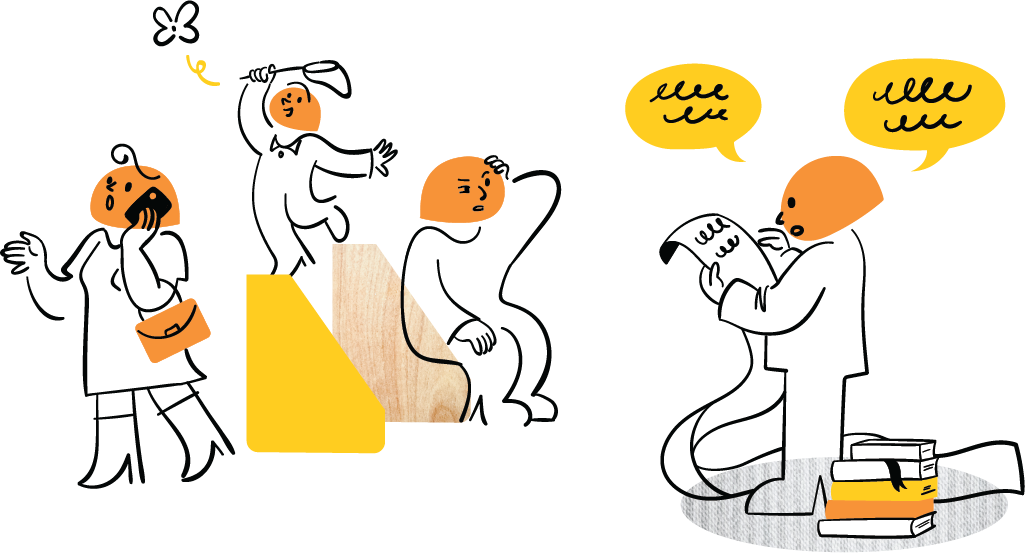









Teams complete training. But still:
New hires take too long to perform independently
Employees hesitate or make mistakes in real situations
Customers misunderstand products despite clear explainers
Knowledge from training doesn't transfer to correct behavior
The information is usually already there. What breaks down is how people make sense of it when it matters.
Where Understanding Breaks Down
Healthcare information has specific properties that make it resistant to standard communication formats. Here is why animation is a functional necessity, not just an aesthetic choice:

1. False Certainty
People follow an explanation, feel they understand, then act incorrectly when the real situation arrives.
A sales rep completes product training, passes the assessment, then consistently mispositions the product with enterprise clients - because the training showed what the product does, not how the underlying logic works.
The explanation felt clear. The system behind it was never visible. > Errors go undetected because no one realizes the understanding was wrong to begin with.
2. Cognitive Overload
People cannot keep up, disengage mid-way, or complete training without retaining anything usable.
A new hire sits through a 45-minute onboarding module covering systems, policies, workflows, and culture. By week two, they're still asking questions the training was supposed to answer.
Too much arrived at once, without structure or priority. > The same training gets repeated. The same gaps remain.
3. Fragmentation
People remember individual pieces but cannot connect them when a real situation requires the whole picture.
A customer service team knows the refund policy, the escalation procedure, and the system steps - separately. Under pressure, they default to whichever piece feels most relevant, not whichever is correct.
The parts were taught. The system was never shown. > Performance becomes inconsistent across the team, even with identical training.
4. Transfer Failure
People demonstrate understanding in training, then hesitate or act incorrectly when real conditions apply.
Clinical staff complete a safety protocol module correctly. On the floor, under time pressure and with a non-standard patient situation, the protocol breaks down - not because they forgot it, but because training never showed them how it applies when things don't go as expected.
The knowledge existed. The context to activate it didn't. > Supervision stays high. Time-to-independent performance stays long.
Environments where this matters
These failures show up wherever complex knowledge must translate into correct action.
Training & Learning

Onboarding & role-based quick-start training: New hires complete onboarding but take weeks to perform independently — because training showed policies, not how real work decisions are made.
Compliance & safety training: Employees pass assessments but freeze in real situations — because rules were memorized, not the system behind them.
Cybersecurity awareness & phishing training: Staff recognize textbook threats but miss real ones — because training showed examples, not how to read live signals.
Leadership & soft skills training: Managers understand frameworks in sessions but default to old behavior under pressure — because concepts were never connected to real decision moments.
Communication & Product Education

Product & service explainer videos: Customers watch the explainer and still misuse the product - because the video showed features, not how the underlying logic works.
Customer onboarding & usage education: Users drop off during onboarding - because steps were listed without showing how each one connects to outcomes they care about.
Internal strategy & change communication: Teams hear the new direction but interpret it differently across functions - because the reasoning behind decisions was never made visible.
Healthcare & High-Stakes Environments

Patient education: Patients leave consultations feeling informed but follow instructions incorrectly — because explanations described what to do without showing why each step matters.
Medical & healthcare professional education: Clinicians know the protocol but hesitate in atypical situations — because training covered standard cases without building the judgment to adapt.
Medical device & pharma product explainer: Users operate devices incorrectly despite reading the manual — because instructions listed steps without revealing how the system responds to each action.
Clinical safety & compliance training: Staff complete mandatory training but inconsistencies persist across teams — because procedures were taught in isolation, not as an interconnected system.
How visual communication changes comprehension
Most content treats visuals as presentation. F.Learning treats visual communication as a structural explanation tool.
How something is shown determines whether people can understand how it works — not just what it is.
Visual in general Structure. Relationship. System. Static visuals reveal how parts connect — making fragmentation and false certainty visible before they become performance problems.
Animation specifically Process. Sequence. Decision in motion. Animation shows how a system behaves over time. It controls the order understanding is built. It makes visible what words alone cannot convey without losing precision.
This is not an argument for animation as a style preference. It is why visual explanation is the most direct tool for the four failures described above.
| Failure | What visual addresses |
|---|---|
| False Certainty | Makes hidden mechanisms visible |
| Cognitive Overload | Controls pace and sequence of processing |
| Fragmentation | Shows relationships between parts |
| Transfer Failure | Places knowledge inside real decision contexts |
The principles behind F.Learning's communication approach
F.Learning works from four core principles. Each one maps directly to a failure type. Each one changes how an explanation is built, not just how it looks.
| Principle | What Fails | Our Response |
|---|---|---|
| Reveal Mechanisms | People follow the surface without understanding what drives the system. | Make the underlying system visible — showing how components connect, what causes what, and why outcomes happen. |
| Structure Information | Complexity arrives faster than people can process it. | Organize information into progressive layers that guide understanding step by step. |
| Build Mental Models | Knowledge exists in isolated fragments with no larger structure. | Show relationships, hierarchies, and logic so audiences can understand the whole system, not just individual parts. |
| Contextualize Knowledge | Information stays abstract and difficult to apply in real situations. | Place knowledge inside realistic contexts so people recognize when and how it should be used. |
Visualizing
complexity in practice
Explore how healthcare organizations use animation and visual explanation to support procedure preparation, treatment understanding, chronic condition education, recovery communication, and patient confidence.
Geoff Lawton's Permaculture Design Course
Failure type
False Certainty
Live footage showed learners what a permaculture farm looked like. They recognized the examples and felt the content was clear. But the mechanisms behind the scenes — energy flows, spatial relationships, cause-and-effect between living systems — were invisible on screen. The system remained hidden while learners believed they understood it.
Before
Learners could watch a real environment and follow Geoff's explanation. They couldn't build the mental model needed to apply principles across different sites and climates.
After
330 animated videos added a visual explanation layer to the existing footage — making invisible flows, structural logic, and system relationships visible alongside the real-world examples. Each medium was given a distinct role: live-action showed the environment, animation revealed the system behind it.
UNSW Sydney — Business Finance (FINS1613)
Use case
Fragmentation
Failure type: Fragmentation Lectures and storyboards covered the content. Students could recall individual steps from each flowchart. But without seeing how the processes connected into a larger decision structure, they struggled to apply the logic across different scenarios — understanding the parts without navigating the whole.
Before
Flowcharts as static reference. Students followed the steps; few could reason through why decisions branched the way they did.
After
Three animated videos rebuilt the flowcharts as visible system logic — showing not just what each step was, but how decisions flowed, where they led, and what each path meant for the outcome.
Dioxycle — Energy System Keynote Presentation
Failure type
Fragmentation
The audience — PhDs, professors, and researchers — already understood wind turbines and electrolyzers as separate technologies. The gap wasn't knowledge of the parts. It was seeing how these systems reshape each other inside a real energy ecosystem: how intermittency, infrastructure constraints, and direct coupling allow both to co-evolve. Existing diagrams showed the components. None showed the relationship.
Before
Researchers understood each technology in isolation. The system-level interdependency — the actual subject of the research — had no adequate visual representation.
After
A 3-minute 3D visualization made the hidden co-evolution visible: how wind turbine design changes when paired directly with an electrolyzer, how electrolyzer architecture adapts in response, and what the combined system makes possible at scale.
Frequently Asked Questions
Is this just another term for visual learning or e-learning?
No. Visual learning describes a preference. Visualizing Complexity describes a design problem — how complex knowledge breaks down during interpretation, and what structural responses fix it. The approach applies to any format; animation is one execution tool, not the definition.
What's the difference between simplifying content and Visualizing Complexity?
Simplification removes complexity. Visualizing Complexity preserves it while making it navigable. A medical protocol or compliance framework cannot be simplified without losing meaning — but it can be structured so people understand the logic, not just the steps.
When does this approach not solve the problem?
When the problem isn't understanding. If people aren't acting correctly because of motivation, culture, or organizational constraints — visual explanation won't fix it. This framework works specifically when the gap is between knowing and correctly interpreting or applying.
Which failure type is most common?
False Certainty is the most underdiagnosed. It's invisible at the point of training — people complete modules, pass assessments, and report the content was clear. The failure only surfaces when performance breaks down in real situations.
How is this different from instructional design?
Instructional design structures the learning experience — objectives, sequencing, assessment. Visualizing Complexity focuses on how knowledge is explained at the point of delivery. A well-designed learning experience can still contain explanations that produce False Certainty or Transfer Failure. Both layers need attention.
Can this apply to text-based content, not just animation?
Yes. The principles apply regardless of format. Animation executes them more directly — particularly when systems, relationships, and sequences need to be made visible — but the diagnostic thinking applies to any medium.
How do you identify which failure type is active?
Look at what the learner consistently does in their work, not what they say they understand.
False Certainty → The learner sounds confident, repeats terminology correctly, but makes basic mistakes when applying the knowledge independently.
Overload → The learner gets stuck, asks for repeated clarification, misses steps, or struggles to complete tasks without heavy guidance.
Fragmentation → The learner can explain individual concepts or procedures, but cannot connect them to make decisions, prioritize actions, or navigate unfamiliar situations.
Transfer Failure → The learner performs well in training, simulations, or familiar examples, but fails to apply the same principles when real-world variables and constraints appear.
The key question is not "What mistake did they make?" but "What pattern of behavior keeps repeating?"
How is working with F.Learning different from a standard animation studio?
Most vendors solve a production problem: create the asset, deliver on time. F.Learning works from the understanding problem backward — diagnosing the failure, designing the explanation to address it, then producing the content. Strategy, learning design, and production exist in one workflow so clarity decisions aren't lost between teams.
What knowledge benefits most from this approach?
Knowledge that is complex, high-stakes, applied (must be used in real conditions, not just recalled), or consistently misunderstood despite repeated training. Healthcare, compliance, technical onboarding, and product education consistently fall here.

Not: how do we make this content more engaging. But: where is understanding breaking down — and what does the explanation need to do differently.
If you're dealing with a gap between training completion and correct performance, or between explanation and actual understanding, this is the problem we're built for.